
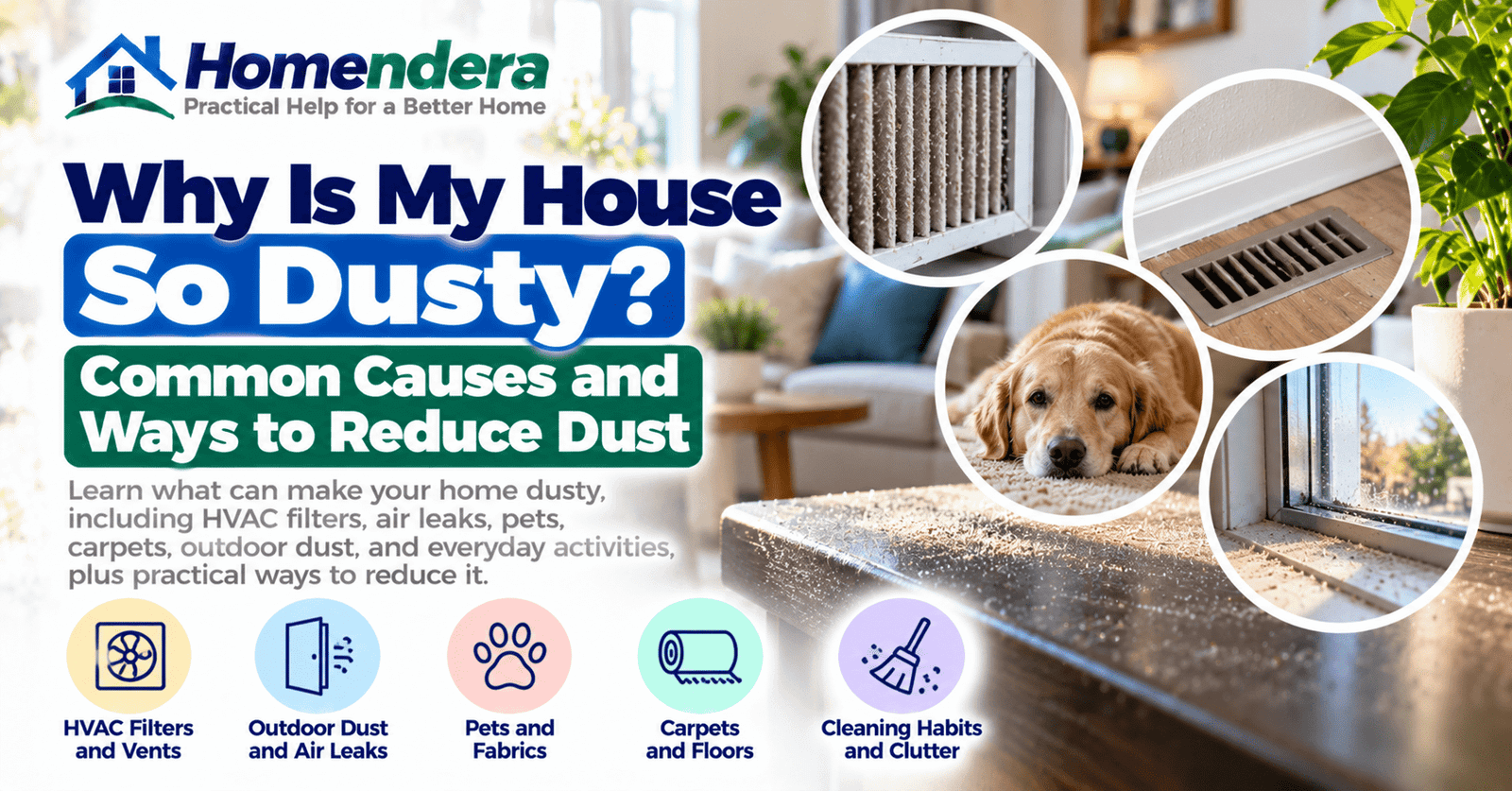
Dust is a normal part of every home. However, if surfaces seem dusty again shortly after cleaning, there may be more contributing to the problem than ordinary household activity.
Dust can enter from outdoors, move through the HVAC system, collect in fabrics, or come from everyday materials inside the home. Air leaks, dirty filters, renovation work, pets, and cleaning habits can also affect how quickly it builds up.
If you’re wondering why your house is so dusty, start by identifying where the dust appears fastest and what may be contributing to it.
What Is Household Dust?
Household dust is a mixture of many small particles.
Depending on the home, it can contain:
- Soil and outdoor particles
- Fibers from clothing and fabrics
- Hair
- Skin particles
- Pet hair and dander
- Pollen
- Tiny pieces of paper or other materials
- Particles from household activities
Because dust has many sources, there is rarely one single solution.
The goal is usually to reduce how much dust enters, circulates, and settles around the home.
1. Check Your HVAC Air Filter
The HVAC filter is a sensible first place to check.
A filter that is heavily loaded with dust may no longer support normal airflow and filtration as intended.
Inspect it according to your HVAC manufacturer’s instructions.
Replace it when necessary with the correct size and a filter type suitable for your system.
Our guide on how often you should change your HVAC air filter explains why replacement frequency varies from one home to another.
2. Do Not Assume a Higher-Rated Filter Is Always Better
It can be tempting to install the most restrictive filter available.
However, HVAC systems are designed for particular airflow conditions.
A filter that creates excessive resistance may reduce airflow and affect system performance.
Use a filter compatible with your equipment.
If you want to improve filtration significantly, ask an HVAC professional whether your system can accommodate the filter you are considering.
3. Make Sure the Filter Fits Correctly
A filter that does not fit properly may allow air to move around its edges.
Check that:
- The dimensions are correct
- The filter sits properly in its slot
- It is installed in the correct direction
- There are no obvious gaps caused by an incorrect size
Do not force an oversized filter into place or modify one to make it fit.
Follow the equipment manufacturer’s specifications.
4. Check Supply Vents and Return Grilles
Look at accessible HVAC vents and return-air grilles.
Dust often collects on these surfaces because air continually passes through them.
A light layer of dust does not necessarily indicate a problem.
However, unusually heavy accumulation deserves attention.
Clean accessible grille surfaces using an appropriate method. Do not push tools deep into ductwork.
Also make sure furniture, curtains, or other items are not blocking airflow.
5. Look for Dust Around Vent Edges
Dark or dusty areas around vent covers can sometimes result from particles collecting where air moves across nearby surfaces.
This does not automatically mean the ducts are extremely dirty.
Check whether the grille:
- Fits properly
- Is securely attached
- Has visible dust buildup
- Is surrounded by gaps
If you notice substantial dust repeatedly appearing around several vents, consider having the HVAC system evaluated.
6. Duct Leakage May Contribute to Dust
Ductwork that passes through dusty, unconditioned areas can sometimes draw in or distribute unwanted particles if it has significant leakage.
Potential areas include:
- Attics
- Crawl spaces
- Garages
- Utility areas
Duct leakage is difficult to diagnose accurately just by looking through a vent.
Professional duct testing may be useful if you have persistent dust along with airflow or comfort problems.
7. Do You Need Your Air Ducts Cleaned?
Visible dust around vents does not automatically mean the entire duct system needs cleaning.
Before paying for duct cleaning, identify whether there is a specific reason.
For example, professional inspection may make sense if there is substantial debris, contamination, pest activity, or another documented problem inside the system.
Routine duct cleaning should not replace:
- Proper filtration
- Leak repair
- Moisture control
- Regular housekeeping
- HVAC maintenance
Correct the source of excessive dust rather than treating ducts as the automatic cause.
8. Outdoor Air Can Bring Dust Inside
Every time an exterior door or window opens, outdoor particles can enter.
The amount depends heavily on the surroundings.
Homes near:
- Busy roads
- Construction
- Dry soil
- Agricultural areas
- Unpaved surfaces
may experience more outdoor dust than homes in other environments.
You cannot eliminate outdoor particles completely, but you can reduce unnecessary entry.
9. Check for Drafts Around Doors and Windows
Air leakage around exterior openings can bring outdoor particles into the home even when doors and windows are closed.
Look for:
- Damaged weatherstripping
- Gaps around frames
- Poorly fitting exterior doors
- Worn door sweeps
- Failed caulk at appropriate stationary joints
Our guide on how to stop drafts around doors and windows explains how to investigate these areas.
Remember that the goal is to reduce unintended leakage without blocking required ventilation or drainage openings.
10. Shoes Can Carry Dust Indoors
Footwear can bring soil, dust, pollen, and other outdoor material into the home.
Using entrance mats can help capture some debris before it spreads.
In homes where it is practical, removing outdoor shoes near the entrance may reduce the amount carried onto floors and carpets.
Clean entrance mats regularly so they do not become another source of loose dust.
11. Pets Can Increase Household Dust
Pets contribute hair, dander, outdoor soil, and other particles.
Dogs that spend time outdoors may carry additional dust inside on their coats and paws.
Useful habits include:
- Regular grooming appropriate for the animal
- Cleaning pet bedding
- Vacuuming areas where pets spend time
- Wiping muddy or dusty paws when practical
Pet-related particles are only one component of household dust, so removing visible hair alone may not solve the whole problem.
12. Carpets Can Hold Large Amounts of Dust
Carpet fibers can capture dust that later becomes disturbed by walking and other activity.
Regular vacuuming can help manage this accumulation.
Use equipment appropriate for the carpet type and maintain the vacuum according to its instructions.
Pay particular attention to:
- High-traffic areas
- Entryways
- Areas beneath furniture
- Stairs
- Rooms used by pets
Hard flooring also collects dust, but it is usually more visible on the surface.
13. Vacuum Cleaner Performance Matters
A vacuum that leaks fine particles back into the room may make cleaning less effective.
Maintain the vacuum properly.
Check:
- Filters
- Bags or dust containers
- Hoses
- Seals
- Brush rolls
Follow the manufacturer’s maintenance schedule.
If household members are sensitive to airborne particles, filtration performance may be particularly important when choosing or maintaining cleaning equipment.
14. Dust With a Damp Cloth
Dry dusting can move particles from one surface into the air, where they eventually settle somewhere else.
For suitable surfaces, a slightly damp microfiber cloth can capture dust more effectively.
Do not use excessive water on materials that can be damaged by moisture.
Clean higher surfaces before lower ones so particles that fall can be collected later.
15. Clean From Top to Bottom
A practical cleaning order is:
- High shelves and surfaces
- Ceiling fans where safely accessible
- Furniture
- Window sills
- Lower surfaces
- Floors
Vacuuming or cleaning the floor last helps collect particles disturbed during the earlier steps.
This simple sequence can make routine cleaning more efficient.
16. Ceiling Fans Can Spread Settled Dust
Fan blades can collect significant dust.
When the fan operates, some of that material may become airborne again.
Turn the fan off before cleaning it.
Use a stable, safe method to reach the blades. Do not balance on chairs or unsuitable furniture.
If the fan requires a high ladder or awkward reach, consider professional help rather than risking a fall.
17. Bedding and Fabrics Produce Fibers
Beds, curtains, upholstered furniture, clothing, blankets, and other fabrics contribute fibers to household dust.
Regular laundering and cleaning can reduce accumulation.
Follow manufacturer care instructions for each material.
Bedrooms may need particular attention because bedding, clothing, and extended occupancy can all contribute particles.
18. Clutter Makes Dust Harder to Control
Decorative objects, stacked items, open shelving, and stored belongings create additional surfaces where dust settles.
You do not need a minimalist home to manage dust.
However, reducing unnecessary clutter can make regular cleaning faster and more effective.
Closed storage may also help protect seldom-used items from dust accumulation.
Our guide on how to improve home storage without major renovations includes practical ways to organize household belongings.
19. Check Window Screens and Sills
Open windows can bring dust and pollen indoors.
Screens themselves can also accumulate debris.
Inspect and clean them appropriately when needed.
Wipe window sills and tracks, particularly if you regularly open the windows.
If you notice significant air movement even when windows are closed, investigate the seals rather than simply cleaning the dust repeatedly.
20. Renovation Work Creates Fine Dust
Drilling, sanding, cutting drywall, removing flooring, and other renovation activities can create large amounts of fine dust.
If work is underway:
- Isolate the work area where practical
- Follow appropriate dust-control methods
- Protect HVAC openings as recommended for the project
- Clean with suitable equipment
- Follow safety requirements for the materials involved
Do not assume all construction dust is harmless.
Older homes may contain materials requiring specialized precautions before sanding, cutting, or demolition.
21. New Furniture and Household Materials Can Shed Particles
Some new carpets, textiles, furniture, and other products may shed fibers or particles, particularly when first installed or used.
This often decreases with time and normal cleaning.
If dust suddenly increases after introducing a new material, consider whether it may be contributing.
Follow the manufacturer’s cleaning recommendations.
22. Fireplaces and Wood-Burning Appliances Can Add Particles
Homes using fireplaces or wood-burning appliances may experience additional dust, ash, or combustion-related particles.
Operate and maintain these appliances according to manufacturer instructions and local safety requirements.
Do not treat combustion particles as ordinary household dust.
Proper venting, chimney maintenance, and combustion safety are important.
Problems involving smoke or combustion should receive qualified professional attention.
23. Very Dry Indoor Air Can Make Dust More Noticeable
When indoor air is very dry, some particles can remain airborne more easily and static electricity may increase.
However, adding excessive humidity is not a good dust-control strategy.
Too much indoor moisture can contribute to condensation and other problems.
Our guide on signs of excess moisture in your home explains why humidity needs to be managed carefully rather than simply increased.
24. Avoid Overusing a Humidifier
If you use a humidifier, follow its instructions and monitor indoor conditions.
Do not raise humidity until windows begin developing heavy condensation simply to reduce dry-air discomfort.
Our guide on condensation on windows explains how excessive indoor moisture can become visible on cold glass.
Balance matters more than maximizing humidity.
25. Check the HVAC System Regularly
Routine HVAC observations can help you catch airflow and filtration issues earlier.
Check:
- Filter condition
- Accessible vents
- Return grilles
- Unusual noises
- Changes in airflow
- Moisture around equipment
Our HVAC maintenance checklist for homeowners provides a broader routine for these checks.
Internal HVAC inspection and repair should be left to qualified professionals.
26. Does Dust Mean Your HVAC System Is Broken?
Not necessarily.
Dust naturally exists in every home.
However, HVAC evaluation may be appropriate when excessive dust occurs along with:
- Weak airflow
- Unusual HVAC noises
- Significant dust blowing from vents
- Frequent filter problems
- Uneven room temperatures
- Visible duct damage
- Major changes after HVAC work
Avoid replacing equipment simply because surfaces become dusty.
First investigate the simpler sources.
27. Air Purifiers Can Help With Some Airborne Particles
Portable air cleaners may reduce certain airborne particles when appropriately selected and used.
However, they do not stop dust from entering through doors, collecting on floors, or being generated by household activities.
If you use one, consider:
- Room size
- Manufacturer specifications
- Filter replacement costs
- Placement
- Noise
- Maintenance requirements
Treat air cleaning as one part of dust management rather than a substitute for cleaning and source control.
28. Avoid Devices That Intentionally Produce Ozone
Some air-cleaning products may intentionally generate ozone or produce it as a by-product.
Ozone can irritate the respiratory system and should not be treated as a desirable indoor air-cleaning method.
Choose indoor air products carefully and follow reliable public-health and manufacturer guidance.
29. Watch for Dust Returning Immediately After Cleaning
Some dust will always return.
However, very rapid accumulation can provide useful clues.
Ask:
- Is it worse near certain vents?
- Is it concentrated near exterior doors?
- Did it begin after construction?
- Is one room much dustier?
- Has the HVAC filter become dirty unusually quickly?
- Are windows frequently open?
- Has nearby outdoor construction started?
Patterns often tell you more than the amount of dust alone.
30. One Dusty Room May Have a Local Cause
If only one room becomes dusty quickly, investigate that room first.
Check:
- Windows
- Exterior doors
- HVAC vents
- Return-air pathways
- Carpets
- Fabrics
- Nearby construction
- Storage
- Room usage
A room near an exterior entrance may naturally receive more outdoor debris.
If it also has comfort problems, our guide explaining why one room is hotter or colder than the others covers airflow and building-envelope factors worth checking.
31. Keep Entry Areas Clean
Dust entering at doors can quickly spread through foot traffic.
Regularly clean:
- Entrance mats
- Floors near doors
- Shoe-storage areas
- Door thresholds
A simple cleaning routine at entrances can prevent some material from spreading throughout the home.
32. Do Not Try to Eliminate Every Particle
A completely dust-free home is unrealistic.
Constantly cleaning every visible particle can consume time without solving the underlying issue.
Focus instead on:
- Source control
- Effective cleaning
- Appropriate HVAC filtration
- Reducing unnecessary air leakage
- Managing high-dust activities
- Keeping fabrics and floors reasonably clean
The aim is a manageable home environment, not perfect elimination.
When Should You Call an HVAC Professional?
Consider professional HVAC evaluation when:
- Dust appears to blow visibly from vents
- Filters become heavily loaded unusually quickly
- Ductwork appears damaged
- Airflow has changed substantially
- Several rooms have airflow problems
- Dust increased dramatically after HVAC work
- You suspect duct leakage
- The system makes unusual noises
Our guide on why your HVAC is making noise can help distinguish simple airflow sounds from symptoms that deserve technical attention.
A Practical Dust-Reduction Routine
If your home seems unusually dusty, work through these steps:
- Inspect the HVAC filter.
- Confirm that the filter fits correctly.
- Clean accessible vent and return grilles.
- Check doors and windows for obvious drafts.
- Clean entrance mats.
- Vacuum carpets and rugs appropriately.
- Damp-dust suitable surfaces.
- Wash bedding and frequently used fabrics.
- Clean ceiling fans.
- Reduce unnecessary clutter.
- Check whether renovation or outdoor activity is contributing.
- Seek HVAC evaluation if unusual vent-related dust continues.
This approach tackles the most common sources without assuming that expensive equipment or services are necessary.
Final Thoughts
If you’re wondering why your house is so dusty, there probably isn’t one single cause.
Outdoor particles, fabrics, pets, carpets, household activities, air leakage, HVAC filtration, and cleaning habits can all contribute.
Start with the HVAC filter, vents, doors, windows, floors, and fabrics. Look for patterns that show where dust appears fastest.
Good filtration and routine cleaning can help, but source control is equally important.
Most homes will never be completely dust-free. The practical goal is to reduce excessive buildup, keep your HVAC system operating appropriately, and identify unusual changes that may point to an airflow or building problem.