
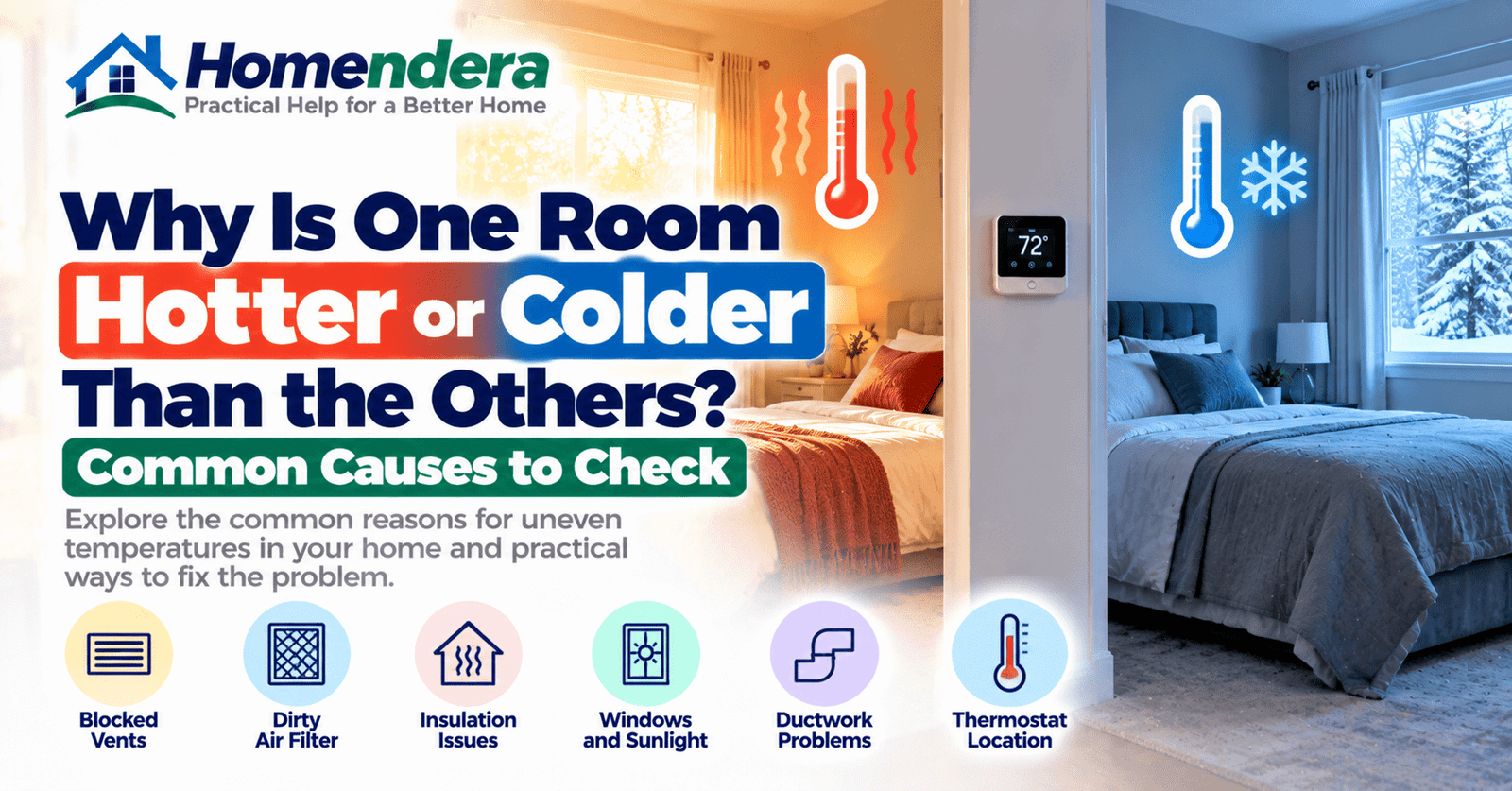
One room that feels much hotter or colder than the rest of the house can be frustrating. You may adjust the thermostat, only to make other rooms uncomfortable while the problem room barely changes.
Uneven room temperatures can have several causes. Some are simple, such as a blocked vent or dirty HVAC filter. Others involve ductwork, insulation, air leakage, sunlight, thermostat location, or the way the HVAC system distributes air.
If one room is hotter or colder than the others, start with simple checks before assuming the HVAC system needs a major repair.
First, Confirm That the Temperature Difference Is Real
Rooms naturally feel slightly different because of sunlight, occupancy, appliances, and their location within the house.
However, a consistently uncomfortable room deserves investigation.
Compare the room with nearby areas at similar times of day. If possible, use the same reliable thermometer rather than relying only on how the rooms feel.
Pay attention to whether the difference occurs:
- All day
- Only in the afternoon
- Only overnight
- During cooling
- During heating
- When doors are closed
- During particularly hot or cold weather
These patterns can provide useful clues.
1. Check the Supply Vent
Start with the vent that delivers conditioned air into the room.
Make sure it is open and not blocked by:
- Furniture
- Curtains
- Rugs
- Boxes
- Storage items
- Other household objects
Then compare the airflow with a similar vent in another room.
You do not need specialized equipment for this first check. You are simply looking for an obvious difference.
Weak airflow in one room may indicate a local airflow problem.
2. Make Sure the Vent Is Actually Open
Adjustable supply registers can accidentally become partially or completely closed.
This may happen during cleaning, furniture rearrangement, or seasonal adjustments.
Check the vent position before looking for complicated HVAC problems.
However, repeatedly closing vents throughout the house is generally not a good way to balance temperatures unless the HVAC system was designed for that approach.
Restricting too many vents can affect system airflow.
3. Check for a Blocked Return-Air Path
Supplying conditioned air to a room is only part of the airflow process.
Air also needs a path back toward the HVAC system.
Some rooms have dedicated return grilles. Others rely on air moving beneath or around doors toward a central return.
A room may become uncomfortable when:
- A return grille is blocked
- Furniture covers the return
- A door remains tightly closed
- The return-air path is inadequate
Do not modify doors, walls, or ductwork without understanding how the system was designed.
If closing the door consistently makes the room uncomfortable, mention this to an HVAC professional.
4. Inspect the HVAC Air Filter
A dirty filter can restrict airflow throughout the system.
Although this often affects more than one room, rooms farther from the HVAC equipment may sometimes make airflow problems more noticeable.
Check the filter according to the manufacturer’s instructions.
Replace it when necessary using the correct size and an appropriate type.
Our guide on how often you should change your HVAC air filter explains why replacement frequency depends on the home, filter, system, and operating conditions.
5. Compare Airflow Between Rooms
With the HVAC system running, compare the affected room with a nearby comfortable room.
Ask:
- Does the affected room receive noticeably less air?
- Does airflow seem normal but the room still stays uncomfortable?
- Does the problem change when the door is open?
- Is the room farther from the HVAC equipment?
- Are several rooms in the same area affected?
Weak airflow points you toward a different set of causes than strong airflow combined with poor temperature control.
6. Check Whether Furniture Is Affecting Air Circulation
Furniture can interfere with both supply and return airflow.
Large sofas, beds, cabinets, or curtains may prevent conditioned air from circulating properly.
Move obvious obstructions where practical.
Also consider the overall room layout.
Air coming from a vent needs enough space to mix with the rest of the room rather than becoming trapped behind furniture.
7. Look at the Windows
Windows can strongly influence room temperature.
A room with large windows may gain substantial heat from sunlight during warm weather or lose more heat during cold weather.
Check for:
- Visible gaps
- Damaged seals
- Deteriorated weatherstripping
- Poorly closing windows
- Strong drafts
- Intense direct sunlight
A room that becomes hot mainly during sunny afternoons may have more of a solar-heat problem than an HVAC problem.
8. Consider Direct Sunlight
Room orientation matters.
A room receiving strong afternoon sun can become warmer than rooms on the shaded side of the house.
Possible improvements may include suitable:
- Curtains
- Blinds
- Shades
- Exterior shading where appropriate
Window coverings can reduce unwanted solar heat while still allowing you to use natural light when conditions permit.
Our guide to energy-efficient home improvements includes other practical ways to improve household comfort and efficiency.
9. Check Exterior Doors
An exterior door with damaged weatherstripping or poor alignment can allow outdoor air to enter.
Inspect around the edges when the door is closed.
Look for:
- Visible gaps
- Damaged weatherstripping
- Light entering around the edges
- Drafts
- A door that does not close evenly
If the door itself is misaligned, our guide on how to fix a door that won’t close properly covers several basic checks.
Do not simply add thicker weatherstripping if the real problem is door alignment.
10. Look for Other Air Leaks
Air leakage can occur around more than windows and doors.
Potential locations may include penetrations and poorly sealed areas around the building envelope.
You may notice a problem when a room feels particularly uncomfortable during windy weather.
Some air-sealing work is straightforward, while other areas are difficult to diagnose without professional testing.
Avoid sealing openings that are intentionally required for ventilation, combustion safety, drainage, or equipment operation.
11. Consider the Room’s Location
Some rooms naturally face greater heating and cooling loads.
Examples include rooms:
- Above garages
- Beneath attics
- On upper floors
- With several exterior walls
- At the end of long duct runs
- With large windows
- Receiving strong sunlight
- Over unconditioned spaces
The HVAC system should still provide reasonable comfort, but the room’s location can help explain why it behaves differently.
12. Rooms Above Garages Can Be Difficult to Condition
A bedroom above a garage is a common example of an uncomfortable room.
The floor may border an unconditioned space, while the room may also have exterior walls and roof exposure.
Insulation and air sealing can therefore become particularly important.
Do not open walls or ceilings simply to check insulation unless you understand the construction and potential hazards.
A professional energy assessment may be useful when the temperature difference is substantial.
13. Upper Floors May Be Warmer
Warm air tends to rise, and upper levels can receive more heat from the roof and attic.
During summer, upstairs rooms may therefore be harder to cool.
However, a very large difference should not automatically be dismissed as normal.
Check:
- Airflow
- Filters
- Vents
- Windows
- Attic-related heat exposure
- Thermostat behavior
If an entire upper floor is consistently uncomfortable, professional evaluation of airflow and system design may be worthwhile.
14. Insulation May Be Part of the Problem
Insulation helps slow heat transfer between conditioned rooms and outdoor or unconditioned spaces.
A room with missing, damaged, compressed, or inadequate insulation may gain or lose heat more rapidly than other rooms.
Possible clues include:
- Exterior walls that feel unusually hot or cold
- Large seasonal temperature differences
- A room beneath an attic that overheats
- Floors above unconditioned spaces that become very cold
- High heating or cooling demand in one area
Determining insulation condition may require professional inspection.
15. Check for Signs of Moisture Before Adding Insulation
Do not assume every uncomfortable wall simply needs more insulation.
Moisture problems should be addressed first.
Look for:
- Water stains
- Peeling paint
- Soft materials
- Musty odors
- Discoloration
- Dampness
Adding insulation over an unresolved moisture problem can hide damage rather than solve it.
Our guide on how to inspect your home for water damage explains useful warning signs.
16. Ductwork May Be Restricting Airflow
If one room receives much less airflow than others, the duct serving it may have a problem.
Possible issues can include:
- Disconnected ductwork
- Damaged ducts
- Restrictions
- Poor duct design
- Leakage
- Incorrect balancing
Most duct problems cannot be properly diagnosed by looking through the room vent.
Avoid cutting into ceilings or walls to search for ductwork.
An HVAC professional can measure airflow and inspect accessible duct sections.
17. Duct Leakage Can Waste Conditioned Air
A damaged or poorly connected duct may lose heated or cooled air before it reaches the room.
This can be especially important when ducts pass through:
- Attics
- Crawl spaces
- Garages
- Other unconditioned areas
The affected room may receive weak airflow even though the HVAC equipment appears to operate normally.
Professional duct testing can help confirm leakage when visual inspection is not possible.
18. Duct Balancing May Be Needed
HVAC systems distribute air through multiple duct branches.
In some homes, one area receives too much conditioned air while another receives too little.
Balancing involves adjusting airflow so rooms receive appropriate amounts.
This is more precise than randomly closing room vents.
If uneven temperatures persist despite basic checks, an HVAC professional can measure airflow and determine whether balancing is appropriate.
19. Check the Thermostat Location
The thermostat usually measures temperature in one location.
That location may not represent every room equally.
For example, a thermostat in a central hallway may reach its target temperature while a sunny bedroom remains warm.
Thermostat location can be problematic if it is influenced by:
- Direct sunlight
- Drafts
- Nearby supply vents
- Heat-producing appliances
- Exterior doors
- Unusual airflow
Our guide to common thermostat problems at home explains other thermostat-related issues worth checking.
20. Do Not Constantly Adjust the Thermostat for One Room
Lowering the thermostat significantly because one room is warm may overcool the rest of the home.
Likewise, raising the heating temperature for one cold room can make other areas too warm.
The better approach is to identify why the room behaves differently.
The thermostat controls the system. It does not necessarily correct uneven airflow, poor insulation, solar heat gain, or duct problems.
21. Check Ceiling Fans
A ceiling fan can improve how comfortable a room feels by moving air.
During warm weather, air movement can make occupants feel cooler even though the fan does not actually lower the room’s air temperature.
Some fans also allow seasonal direction changes according to the manufacturer’s instructions.
Turn fans off when rooms are unoccupied if their purpose is primarily occupant comfort.
A fan should complement HVAC performance rather than hide a serious airflow problem.
22. Consider Heat-Producing Equipment
Some rooms contain more heat-producing equipment than others.
Examples include:
- Computers
- Gaming systems
- Televisions
- Multiple monitors
- Cooking appliances
- Other electronics
Several people occupying a small room can also add heat.
If the room becomes uncomfortable only while equipment is running or several people are present, internal heat gain may be contributing.
23. Keep Interior Doors in Mind
Some HVAC systems maintain better room-to-room airflow when interior doors are open.
If a bedroom becomes uncomfortable every night after the door closes, the return-air path may deserve attention.
Do not simply cut openings into doors or walls.
An HVAC professional can determine whether the room needs a better return-air solution.
24. Pay Attention to New HVAC Noises
Uneven temperatures combined with unusual HVAC sounds may indicate a developing system problem.
Listen for:
- Rattling
- Whistling
- Grinding
- Buzzing
- Banging
- Unusual cycling sounds
Our guide on why your HVAC is making noise explains which sounds may have simple causes and which deserve professional attention.
25. What If the AC Runs but the Room Stays Hot?
If the entire home struggles to cool rather than only one room, broaden your troubleshooting.
Check basic issues such as:
- Thermostat settings
- Air filter condition
- Blocked vents
- Outdoor-unit surroundings
- Whether the system is operating normally
Our guide on why your AC is running but not cooling the house provides a more appropriate starting point when cooling problems affect much of the home.
26. Do Not Modify HVAC Equipment Yourself
Uneven temperatures can tempt homeowners to make major changes to ducts, dampers, fans, or HVAC equipment.
Avoid unplanned modifications.
Poor changes can affect:
- Airflow
- System pressure
- Efficiency
- Equipment performance
- Indoor comfort
Internal HVAC repairs may also involve electrical components, refrigerant, combustion equipment, or other hazards.
Professional diagnosis is appropriate when basic checks do not reveal the cause.
27. When Should You Call an HVAC Professional?
Consider professional help when:
- One room remains significantly uncomfortable
- Airflow from one vent is much weaker
- Several rooms have uneven temperatures
- You suspect damaged or disconnected ducts
- The HVAC system frequently cycles
- Unusual equipment noises occur
- The system cannot maintain temperature
- You suspect duct-balancing problems
- Basic filter and vent checks make no difference
A technician can measure airflow and temperature differences rather than relying on guesswork.
A Simple Troubleshooting Order
When one room is hotter or colder than the others, check things in this order:
- Compare the temperature with nearby rooms.
- Check the supply vent.
- Remove furniture or curtains blocking airflow.
- Check return-air grilles and pathways.
- Inspect the HVAC filter.
- Compare airflow between rooms.
- Check windows and exterior doors.
- Consider direct sunlight.
- Look for signs of moisture or insulation problems.
- Observe thermostat behavior.
- Note whether unusual HVAC sounds are present.
- Seek professional airflow or duct evaluation if the problem continues.
Starting with simple checks helps avoid unnecessary changes to the HVAC system.
If you notice noticeable air movement around an opening, see how to stop drafts around doors and windows for practical checks and sealing options.
Final Thoughts
If one room is hotter or colder than the others, the HVAC equipment itself is only one possible cause.
Start by checking vents, returns, the air filter, furniture placement, windows, doors, and sunlight. Then consider insulation, room location, ductwork, and thermostat placement.
The pattern matters too. A room that overheats only during sunny afternoons points toward a different problem from one receiving weak airflow throughout the day.
Avoid trying to balance the home by randomly closing vents or repeatedly changing the thermostat.
When basic checks do not explain a significant temperature difference, professional airflow measurements can help identify the real cause and lead to a more effective solution.