
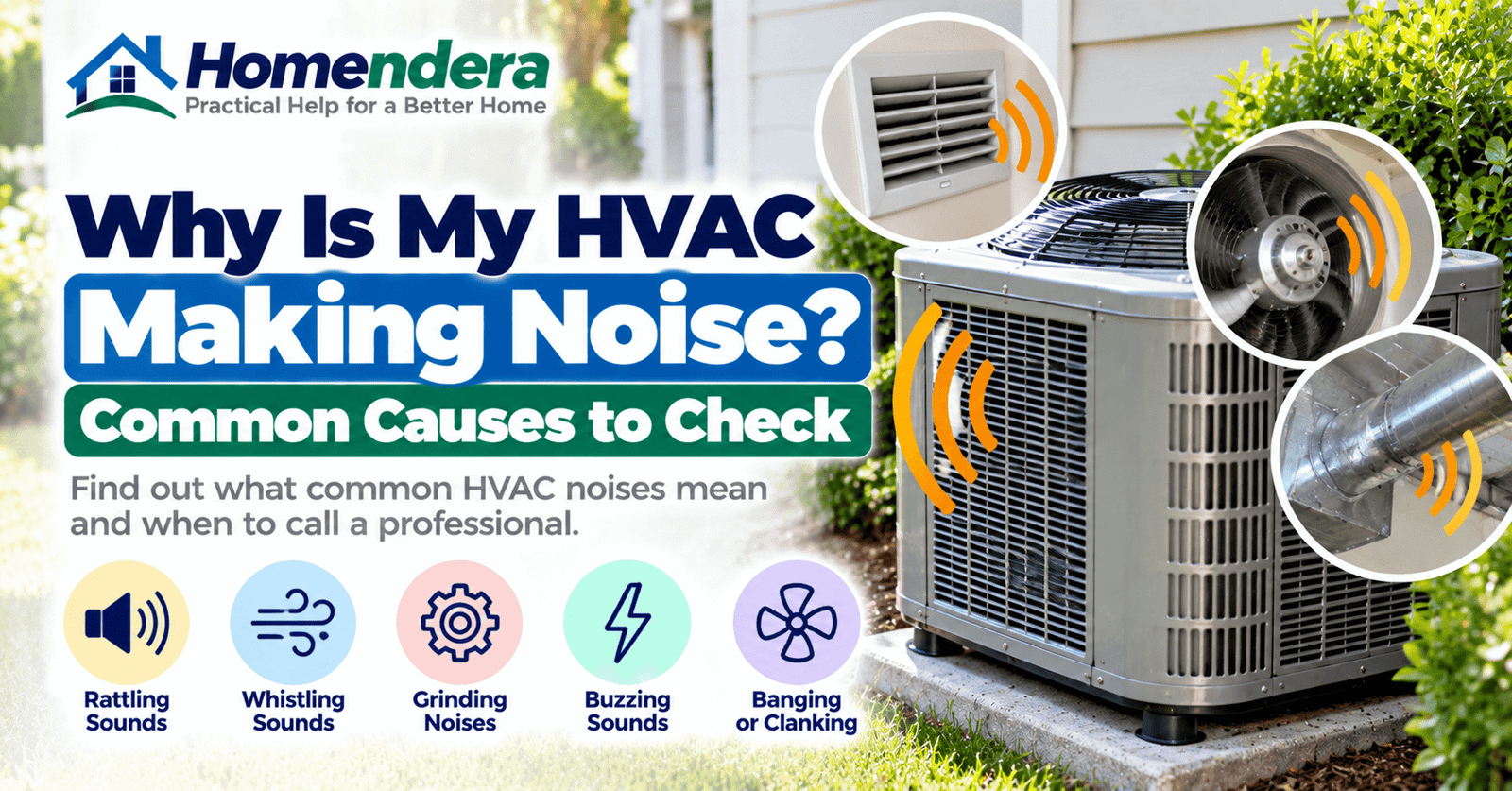
An HVAC system normally makes some sound while it runs. You may hear air moving through vents, a fan starting, or equipment cycling on and off. However, a new, unusually loud, or persistent noise can indicate that something needs attention.
Different sounds can point toward different causes. A rattling vent may have a simple explanation, while grinding, electrical buzzing, or loud mechanical noises may require professional service.
If you’re wondering why your HVAC is making noise, this guide explains common sounds, simple checks homeowners can make, and signs that it is better to stop troubleshooting and call an HVAC professional.
First, Determine Where the Noise Is Coming From
Before trying to diagnose the sound, identify its general location.
Listen near:
- Supply vents
- Return-air grilles
- The thermostat area
- Indoor HVAC equipment
- Accessible ductwork
- The outdoor unit
- Nearby doors, cabinets, or furniture
Sometimes a sound that appears to come from HVAC equipment actually comes from a loose vent cover or another object vibrating when the system operates.
Do not remove equipment panels or reach inside machinery simply to locate a noise.
1. Rattling Sounds
Rattling is one of the more common HVAC noises.
Possible causes include:
- A loose vent cover
- A loose accessible panel
- Debris near an outdoor unit
- Ductwork movement
- A loose component
- Nearby objects vibrating
Start with visible, accessible areas.
Check whether a vent grille is loose or whether an object near the equipment begins vibrating when the system runs.
Do not open internal equipment compartments to search for loose components.
2. Check Vent and Return Grilles
A loose grille can vibrate as air passes through it.
Inspect accessible vent covers and return grilles.
Look for:
- Loose screws
- Bent sections
- Poor fit
- Objects resting against them
- Excessive visible dust
If a simple grille screw is loose, carefully tightening it may solve the problem.
Avoid overtightening screws, particularly when the grille is attached to drywall or another easily damaged surface.
3. Whistling From a Vent
A whistling sound often involves airflow.
Air moving through a narrow opening or restriction can create a high-pitched sound.
Possible causes include:
- A partially closed vent
- Restricted airflow
- A dirty air filter
- An obstructed return grille
- A duct or register issue
Check whether accessible vents are open and unobstructed.
Do not intentionally close many vents in an attempt to redirect airflow unless your HVAC system is designed for that approach.
4. Check the HVAC Air Filter
A dirty or excessively restrictive filter can affect airflow.
Depending on the system, reduced airflow may contribute to unusual sounds around returns, vents, or equipment.
Inspect the filter according to your HVAC manufacturer’s instructions.
Replace it when necessary with the correct size and an appropriate type for the system.
Our guide on how often you should change your HVAC air filter explains why replacement frequency depends on conditions in the home rather than one fixed schedule.
5. Check for Blocked Return-Air Grilles
Return grilles need adequate airflow.
Furniture, boxes, curtains, or other household items can accidentally obstruct them.
Walk through the home and check that accessible returns are not covered.
Restricted return airflow can affect system performance and may contribute to unusual airflow sounds.
Keeping vents and returns clear is also part of a sensible HVAC maintenance checklist for homeowners.
6. Clicking When the System Starts or Stops
A single click when HVAC equipment starts or stops may be normal.
Thermostats, relays, and other controls can produce ordinary operating sounds.
Repeated clicking is different.
If you hear continuous or rapid clicking, particularly when the system struggles to start, professional inspection may be appropriate.
Electrical controls are not a good area for exploratory DIY repairs.
7. Buzzing Sounds
Buzzing can have several possible causes.
Sometimes vibration from an accessible exterior panel or nearby object creates a buzz. In other cases, buzzing may involve electrical or mechanical equipment.
If the sound appears to come from inside the HVAC unit, do not remove covers and begin testing electrical components.
Professional attention is especially appropriate when buzzing is accompanied by:
- Failure to start
- Burning smells
- Repeated breaker trips
- Flickering or electrical symptoms
- Unusual heat
- Intermittent operation
Electrical problems can present shock or fire risks.
8. Humming Sounds
Some humming is normal because motors and electrical components operate while HVAC equipment runs.
What matters is whether the sound has changed.
A new, unusually loud, or persistent hum may indicate that a component is working differently than before.
If the system hums but does not start normally, turn it off and arrange professional inspection rather than repeatedly trying to restart it.
9. Banging or Clanking
Loud banging or metallic clanking deserves more attention than ordinary airflow noise.
Possible causes may involve:
- Loose mechanical components
- Fan-related problems
- Internal equipment movement
- Ductwork expanding or contracting
- Other mechanical faults
Do not continue running equipment that produces severe mechanical sounds simply to see whether they disappear.
If the sound comes from inside the HVAC equipment, shut the system down when safe to do so and contact a professional.
10. Grinding Sounds
Grinding is generally not a normal HVAC operating sound.
It can indicate a problem involving moving components such as a motor or fan assembly.
Continuing to operate equipment with a serious grinding noise may allow additional damage.
Turn the system off and arrange professional service.
Avoid attempting to lubricate or disassemble HVAC motors unless the manufacturer specifically provides a homeowner maintenance procedure.
11. Screeching or Squealing
A high-pitched squeal or screech may indicate a problem with a moving mechanical component.
Depending on the HVAC design, possible causes can involve motors, bearings, belts, or related components.
These parts are generally beyond routine homeowner maintenance.
A brief minor sound at startup may differ from a continuous loud squeal, but a new persistent sound deserves inspection.
12. Popping Sounds From Ductwork
Metal ductwork can sometimes expand and contract as temperatures change.
This movement may create occasional popping or ticking sounds.
A small amount of thermal movement may be normal.
However, frequent or very loud popping can indicate:
- Duct movement
- Air-pressure differences
- Installation issues
- Airflow restrictions
If the noise is persistent and disruptive, an HVAC professional can evaluate the duct system and airflow.
13. Booming When Heating Starts
A loud boom associated with fuel-burning heating equipment should not be treated as a routine DIY problem.
Delayed ignition or combustion-related issues can be dangerous.
If a furnace or other fuel-burning appliance produces abnormal booming, shut it down when safe and contact a qualified technician.
Do not attempt to adjust burners, gas valves, ignition systems, or combustion components yourself.
14. Gurgling or Bubbling
Some HVAC systems can produce water-related sounds because cooling equipment removes moisture from indoor air.
However, persistent gurgling or bubbling may indicate a condensate drainage issue or another system-specific problem.
Look only at accessible areas for obvious signs of:
- Standing water
- Overflow
- Moisture around equipment
- A visibly blocked accessible drain outlet
Do not dismantle internal components.
Water appearing where it normally should not be deserves attention because it can damage nearby building materials.
15. Dripping Sounds
A cooling system may produce condensation during normal operation, but water should be managed through the system’s drainage design.
If you hear persistent dripping, inspect accessible areas for visible moisture.
Look for:
- Water beneath equipment
- Wet flooring
- Stains
- Damp walls
- Overflowing drain pans where visible
- Musty odors
If moisture has affected surrounding materials, our guide on how to inspect your home for water damage can help you identify additional warning signs.
16. Outdoor Unit Rattling
Outdoor HVAC equipment may collect leaves, twigs, and other debris around it.
With the equipment off, visually inspect the surrounding area.
Remove loose debris from the immediate exterior area where it can be done safely without opening the unit.
Do not insert tools, fingers, or objects through protective grilles.
Internal rattling may involve the fan or another component and should be inspected professionally.
17. Keep the Outdoor Unit’s Surroundings Clear
Plants and stored objects should not crowd outdoor HVAC equipment.
Maintain the clearances recommended by the manufacturer.
Good clearance helps support proper airflow and makes visual inspection easier.
Do not cover operating equipment or build an enclosure around it without considering ventilation and manufacturer requirements.
18. Noise After Changing the Air Filter
If an unusual airflow sound begins immediately after installing a new filter, check whether:
- The filter is the correct size
- It is installed in the proper direction
- It is seated correctly
- The filter type is appropriate for the system
A filter should not be modified to make it fit.
If you are unsure which filter specification is appropriate, consult the HVAC manufacturer’s documentation or an HVAC professional.
19. Noise Along With Poor Cooling
A new noise becomes more significant when system performance also changes.
For example, if the air conditioner makes an unusual sound and the home is no longer cooling properly, the two symptoms may be related.
Our guide on why your AC is running but not cooling the house covers basic airflow, thermostat, filter, and outdoor-unit checks.
Do not repeatedly run malfunctioning equipment if it is producing severe mechanical or electrical noises.
20. Check the Thermostat for Normal Operation
Sometimes frequent starting and stopping can make normal HVAC sounds seem excessive.
Observe whether the thermostat appears to operate normally.
Look for:
- Unexpected temperature settings
- Frequent system cycling
- Incorrect mode selection
- A blank or malfunctioning display
Our guide to common thermostat problems at home covers basic troubleshooting.
Do not open electrical HVAC equipment because you suspect the thermostat is responsible.
21. Frequent Starting and Stopping
An HVAC system that repeatedly starts and stops over short periods may produce frequent clicks, fan sounds, and other operating noises.
This behavior is sometimes called short cycling.
Potential causes vary widely and can involve airflow, controls, equipment sizing, overheating, refrigeration issues, or other system problems.
Basic homeowner checks can include the filter, thermostat settings, and unobstructed vents.
Persistent short cycling deserves professional diagnosis.
22. Listen for Changes, Not Just Noise
HVAC systems differ.
A sound that is normal for one system may be unusual for another.
Therefore, one of the most useful questions is:
Is this sound new or noticeably different?
Pay attention when:
- A quiet system becomes loud
- A familiar hum becomes a grinding noise
- Rattling suddenly appears
- Cycling becomes much more frequent
- A noise becomes progressively worse
Changes often provide more useful information than the absolute volume of the equipment.
23. Do Not Ignore Burning or Electrical Smells
Noise accompanied by a burning, melting, or strong electrical odor deserves prompt attention.
Turn the HVAC system off if it is safe to do so.
If there is smoke, visible fire, or an immediate fire hazard, leave the affected area and contact the appropriate emergency service.
Do not remove panels to search for an electrical failure.
24. Do Not Reach Into Moving Equipment
HVAC equipment can contain fans, motors, belts, electrical components, sharp metal edges, and other hazards.
Never reach through a grille or into equipment while it is operating.
Turning the thermostat off also does not necessarily mean every electrical component is safely de-energized.
Internal inspection and repair should be handled by a qualified HVAC professional.
25. Record the Noise Before Calling for Service
Intermittent sounds sometimes disappear before a technician arrives.
If it can be done safely, make a short audio or video recording without approaching dangerous equipment.
Also note:
- When the sound occurs
- Whether heating or cooling is running
- How long it lasts
- Where it seems loudest
- Whether performance has changed
- Any odors or moisture you noticed
This information may help the technician understand the problem.
When Should You Call an HVAC Professional?
Professional inspection is appropriate when you hear:
- Grinding
- Loud banging or clanking
- Persistent squealing
- Electrical buzzing
- Abnormal booming
- Repeated clicking with startup problems
You should also seek help when unusual noise occurs with:
- Poor heating or cooling
- Water leakage
- Burning odors
- Repeated breaker trips
- Short cycling
- Failure to start
- Significant vibration
Routine airflow sounds and a loose vent cover may have simple explanations. Internal mechanical, electrical, refrigerant, gas, and combustion problems should not be treated as casual DIY projects.
A Simple HVAC Noise Troubleshooting Order
When a new HVAC noise appears:
- Identify where the sound seems to originate.
- Determine what type of sound you hear.
- Check accessible vent and return grilles.
- Inspect the air filter.
- Remove objects blocking airflow.
- Look around the outdoor unit for loose exterior debris.
- Check for visible moisture.
- Observe thermostat operation.
- Note whether heating or cooling performance has changed.
- Stop and call a professional if the sound appears mechanical, electrical, or combustion-related.
This approach helps separate simple household issues from problems requiring technical service.
Final Thoughts
If you’re asking why your HVAC is making noise, start by identifying the sound and where it comes from.
Rattling may come from a loose grille. Whistling can indicate restricted airflow. A dirty filter or blocked return may also change how the system sounds.
However, grinding, loud banging, persistent squealing, electrical buzzing, abnormal booming, or noises accompanied by burning smells should receive professional attention.
Your HVAC system already has a normal sound pattern. Learning that pattern makes it easier to notice when something changes.
Simple maintenance can prevent some airflow-related noises, but internal mechanical and electrical problems should be diagnosed rather than guessed at.