
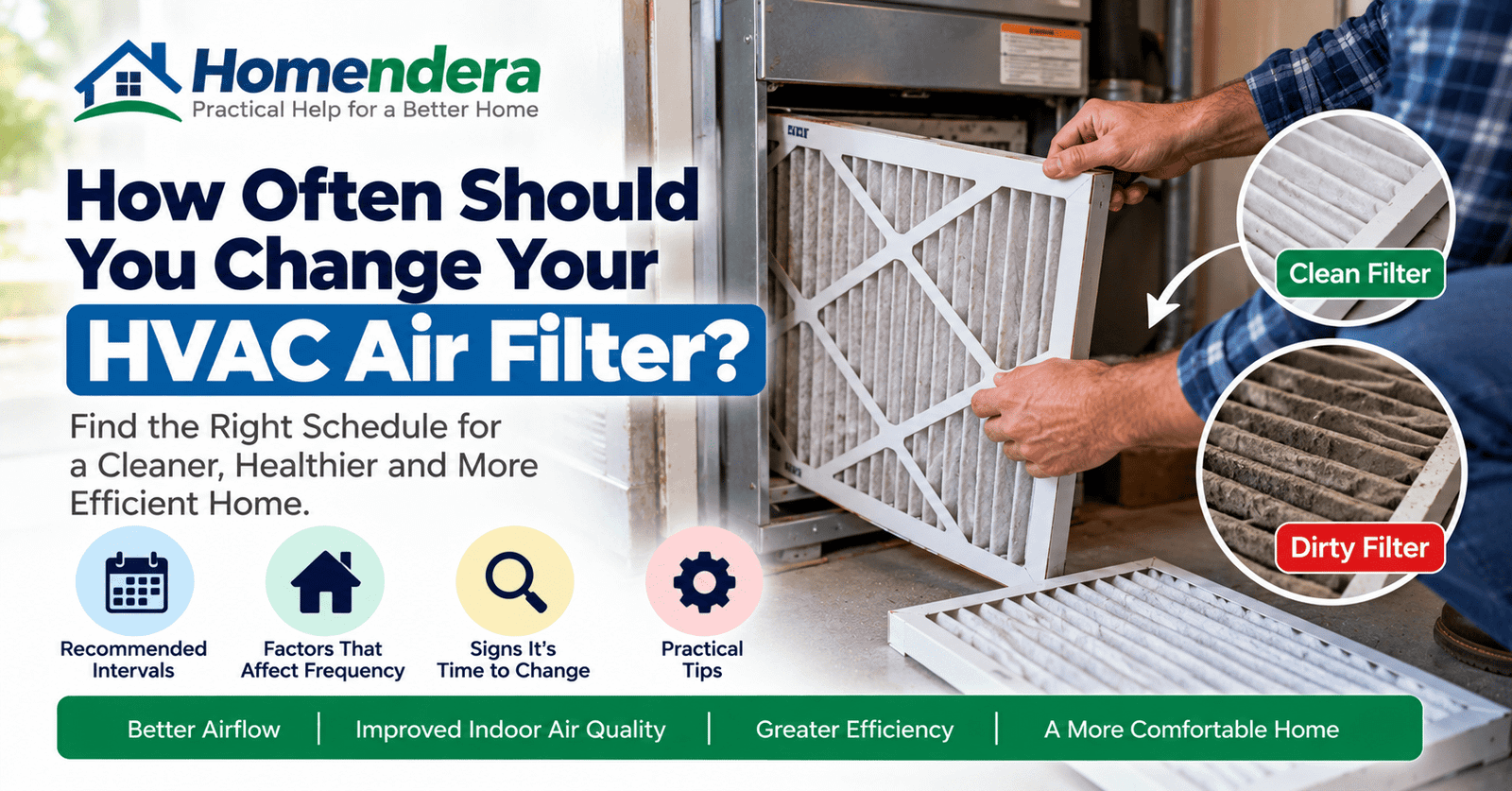
An HVAC air filter may look like a small part of your heating and cooling system, but it plays an important role in maintaining airflow. As the filter collects dust and other airborne particles, it gradually becomes dirty.
So, how often should you change your HVAC air filter? There is no single schedule that works for every home. Filter type, system usage, pets, indoor conditions, and manufacturer recommendations can all affect replacement frequency.
Instead of relying only on the calendar, homeowners should inspect the filter regularly and replace it when its condition or the manufacturer’s guidance indicates that it is time.
Why Your HVAC Air Filter Matters
An HVAC filter captures particles as air passes through the system. This helps prevent excessive debris from reaching certain HVAC components and circulating through the system.
However, the filter becomes more restrictive as material accumulates.
A heavily clogged filter can reduce airflow. Consequently, your heating or cooling system may have to work harder to move air through the home.
Checking the filter is therefore one of the simplest tasks in a regular HVAC maintenance checklist.
How Often Should an HVAC Filter Be Changed?
You may see general recommendations suggesting replacement every one, two, or three months. These intervals can be useful as reminders, but they should not be treated as universal rules.
Some filters may need attention sooner. Others are designed for longer service intervals.
The best starting point is the recommendation provided by your HVAC equipment or filter manufacturer.
After that, inspect the filter periodically. Your actual household conditions will help determine whether the recommended interval works for your home.
Factors That Affect Air Filter Replacement Frequency
Several factors can make an HVAC filter become dirty faster.
Understanding them can help you develop a more appropriate inspection routine.
Filter Type
HVAC filters are available in different materials, thicknesses, sizes, and filtration levels.
A basic filter may have a different replacement schedule from a deeper pleated filter. Therefore, avoid assuming that a schedule used for one filter automatically applies to another.
Check the packaging or manufacturer’s instructions for the specific product you use.
How Often Your HVAC System Runs
A system that operates frequently moves more air through its filter.
During periods of heavy heating or cooling, the filter may collect particles more quickly than during mild weather when the system runs less often.
Consider inspecting the filter more frequently during high-use seasons.
Pets in the Home
Pets can contribute hair, dander, and other particles to the indoor environment.
Homes with one or more pets may therefore find that filters become dirty sooner.
The amount varies considerably depending on the animals, household cleaning routine, HVAC operation, and filter being used.
Dusty Indoor Conditions
Some homes naturally experience more dust than others.
Construction work, renovation projects, frequently opened windows, nearby outdoor dust, and certain household activities can increase the amount of material entering the indoor air.
During unusually dusty conditions, check the HVAC filter more often.
Number of People in the Home
Household activity can also influence indoor particle levels.
A home occupied by several people throughout the day may have different filtration needs from a property that remains empty for long periods.
Again, visual inspection provides more useful information than relying solely on a fixed replacement date.
Smoking or Other Indoor Pollutants
Indoor activities that generate smoke or particles can affect filters.
If your home regularly experiences unusual levels of airborne contaminants, follow appropriate indoor air-quality guidance and inspect the HVAC filter more frequently.
Remember that a standard HVAC filter is not designed to solve every indoor air-quality problem.
How to Tell If Your HVAC Filter Needs Changing
You do not need specialized equipment to perform a basic filter inspection.
Look at the filter under good lighting.
Possible signs that replacement may be appropriate include:
- Heavy visible dust buildup
- A noticeably dark or dirty filter surface
- Debris covering much of the filter
- Reduced airflow compared with normal
- A filter that has reached its manufacturer’s replacement interval
- Physical damage to the filter material
A little discoloration does not always mean immediate replacement is necessary. Compare its condition with the manufacturer’s guidance and your previous inspections.
Check the Filter Instead of Guessing
A simple routine works better than trying to remember an arbitrary number of days.
For example, you can inspect the filter monthly even if the particular filter is designed to last longer.
That does not mean it must be replaced every month. Inspection and replacement are two different things.
Regular checks help you learn how quickly the filter becomes dirty under your household’s actual conditions.
After several inspections, you may notice a predictable pattern.
How to Check an HVAC Air Filter
Before touching HVAC equipment, make sure you can safely access the filter and follow the manufacturer’s instructions.
The filter may be located near:
- A return-air grille
- The air handler
- A furnace
- Another designated filter compartment
Locations vary by system.
If you cannot confidently identify the correct filter location, consult the equipment manual or ask an HVAC professional.
When accessible, carefully remove the filter and note which direction it was installed.
Many filters have an airflow arrow printed on the frame.
Inspect the surface for accumulated dust and debris. Then replace or reinstall it as appropriate.
Install the Filter in the Correct Direction
Airflow direction matters on many HVAC filters.
Look for an arrow printed on the filter frame. It normally indicates the direction air should travel through the filter.
Before removing the old filter, observe its orientation. This makes installing the replacement correctly much easier.
If you are uncertain about the correct direction, check the HVAC manufacturer’s instructions rather than guessing.
Use the Correct Filter Size
A replacement filter should fit the system properly.
Filter dimensions are usually printed on the existing filter frame. However, nominal filter dimensions and actual measurements can sometimes differ.
Check your HVAC system documentation when necessary.
Do not force an incorrectly sized filter into place or leave large gaps around it.
Should You Buy the Highest-Rated Filter Available?
Not necessarily.
Higher filtration does not automatically mean a filter is suitable for every HVAC system.
Some filters create greater resistance to airflow. An HVAC system must be designed to operate properly with the filter being used.
Rather than simply choosing the highest filtration rating available, follow your HVAC manufacturer’s recommendations.
If you want to change significantly to a different filter type or filtration level, an HVAC professional can help determine whether it is appropriate for your system.
Can You Clean and Reuse an HVAC Filter?
That depends entirely on the filter.
Many common disposable filters are designed to be replaced rather than washed.
Some HVAC systems use reusable or washable filters. These require cleaning according to their manufacturer’s instructions.
Never wash a disposable filter simply because it looks dirty. Moisture or cleaning can damage filter material that was not designed for reuse.
Likewise, a reusable filter should be fully maintained according to its specific instructions.
What Happens If You Forget to Change the Filter?
A neglected filter can become heavily loaded with debris.
Possible consequences may include:
- Restricted airflow
- Reduced heating or cooling performance
- Increased strain on some HVAC components
- Longer operating periods
- Uneven comfort
- More dust accumulation within accessible areas
However, these symptoms can also have other causes.
Changing a dirty filter is a sensible first step, but persistent HVAC problems should not automatically be blamed on the filter.
A dirty filter can restrict airflow and contribute to poor cooling. If the problem continues after replacing the filter, see why your AC may be running but not cooling the house.
What If the New Filter Becomes Dirty Very Quickly?
A filter that becomes unusually dirty soon after replacement deserves attention.
First, consider whether household conditions have changed.
Recent construction, renovation work, increased HVAC usage, pets, open windows, or unusually dusty weather may explain the difference.
If there is no obvious reason and filters repeatedly become heavily contaminated much faster than expected, consider asking an HVAC professional to inspect the system.
If surfaces seem dusty again soon after cleaning, see why your house is so dusty for other possible sources, including outdoor air, fabrics, pets, air leaks, and household activities.
What If the Filter Looks Clean for a Long Time?
A filter that remains relatively clean does not necessarily indicate a problem.
System usage and household conditions may simply produce less accumulation.
However, if you suspect that air is bypassing the filter because of an incorrect size, poor fit, or installation problem, have the filter arrangement checked.
The filter should be installed as intended by the equipment manufacturer.
Keep Replacement Filters Available
Keeping the correct replacement filter on hand can make routine maintenance easier.
Write down the required size and filter type so you do not need to remove the existing filter simply to remember what to purchase.
You can also keep a basic maintenance record.
Note:
- Inspection date
- Filter condition
- Replacement date
- Filter type
- Any unusual HVAC symptoms
Over time, this record can help establish a practical replacement pattern for your home.
Combine Filter Checks With Other Home Maintenance
HVAC filter inspection does not need to be a separate complicated task.
Include it in your monthly home maintenance checklist. A quick visual inspection can be performed alongside other routine household checks.
Seasonal changes are another useful reminder. Before periods of heavy heating or cooling, check the filter and other accessible HVAC areas.
Our seasonal home maintenance checklist can help you organize these tasks throughout the year.
When a Filter Change Does Not Solve the Problem
Suppose your HVAC system has weak airflow, runs continuously, makes unusual noises, or struggles to heat or cool the home.
You inspect the filter and discover that it is dirty. Replacing it is a reasonable first step.
However, if the problem continues, do not keep replacing filters hoping that the issue will disappear.
Airflow and performance problems can have many causes. Some require professional diagnosis.
A severely clogged air filter can sometimes contribute to evaporator coil freezing and subsequent water leakage. Learn more about air conditioner water leaks and their causes.
When to Contact an HVAC Professional
Professional assistance may be appropriate if:
- Airflow remains weak after installing a suitable clean filter
- The system repeatedly overheats or shuts down
- Filters become unusually dirty very quickly
- You cannot identify the correct filter
- The filter does not fit properly
- Heating or cooling performance continues to decline
- You notice unusual electrical or mechanical symptoms
Avoid opening electrical compartments or dismantling HVAC equipment to investigate a filter-related concern.
As explained in our guide to DIY vs professional repair, a simple maintenance task should not turn into an unsafe technical repair.
A Simple HVAC Filter Routine
For most homeowners, the easiest approach is straightforward:
Inspect regularly → follow manufacturer guidance → replace when appropriate → record the date → watch for unusual changes.
This method is more useful than treating one replacement interval as correct for every home.
Your own system and household conditions should guide the final schedule.
Final Thoughts
So, how often should you change your HVAC air filter?
There is no universal replacement interval. Start with the filter and HVAC manufacturer’s recommendations, then inspect the filter regularly and adjust your routine according to actual conditions in your home.
Homes with heavy HVAC use, pets, dust, or other airborne particles may require more frequent attention. Other households may find that their filters remain serviceable longer.
Most importantly, make filter inspection part of routine HVAC maintenance. It takes little time and can help you notice airflow and filtration issues before they are forgotten.