
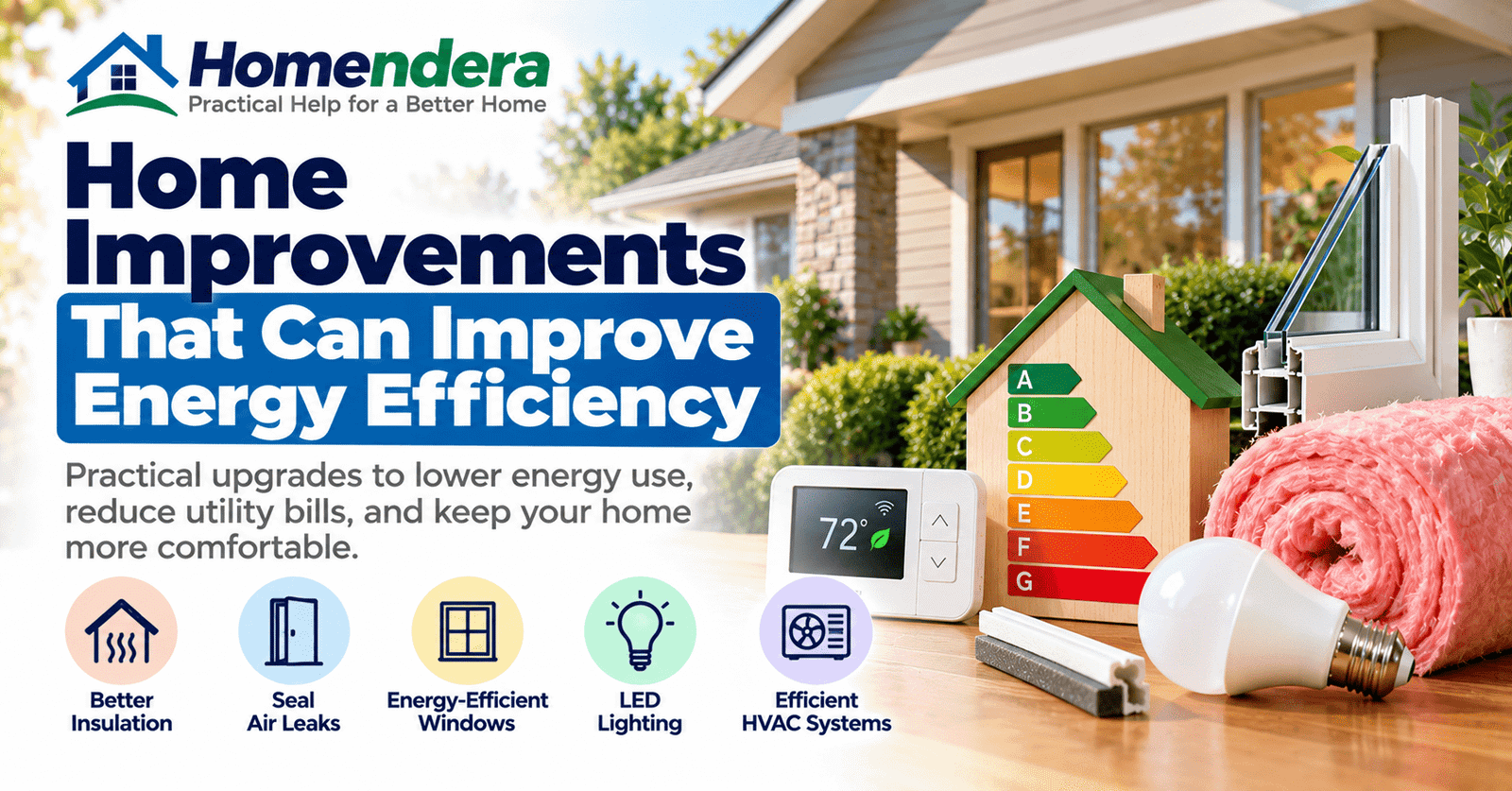
Improving a home’s energy efficiency does not always require a complete renovation. Some relatively simple upgrades can reduce unwanted heat loss or gain, improve comfort, and help heating and cooling systems work more effectively.
However, every home is different. An improvement that produces noticeable savings in one property may have a smaller effect in another. Climate, construction, existing insulation, HVAC equipment, and household habits all matter.
This guide covers practical energy-efficient home improvements and explains where homeowners may want to start before spending money on major upgrades.
1. Start by Finding Where Energy Is Being Wasted
Before buying new windows, insulation, or HVAC equipment, look for obvious sources of energy loss.
Walk through the home and check for:
- Drafts around exterior doors
- Damaged weatherstripping
- Windows that do not close properly
- Unsealed gaps in appropriate locations
- Poor attic insulation
- Blocked HVAC vents
- Dirty HVAC filters
- Excessive direct sunlight during hot weather
- Rooms that are consistently too hot or cold
These observations can help you decide which improvements deserve attention first.
Our guide to simple home improvements includes several smaller upgrades that can improve everyday comfort without major remodeling.
2. Improve Weatherstripping Around Doors
Exterior doors can allow unwanted air movement when weatherstripping becomes worn, compressed, damaged, or missing.
Inspect the perimeter of each exterior door while it is closed. Look for obvious gaps and areas where the seal no longer makes proper contact.
Replacing deteriorated weatherstripping can be a relatively inexpensive improvement.
However, check door alignment first. New weatherstripping will not fully solve the problem if the door itself does not close correctly.
If alignment is the issue, see our guide on how to fix a door that won’t close properly.
3. Seal Appropriate Air Leaks
Small gaps can allow conditioned indoor air to escape and outdoor air to enter.
Potential leakage points may occur around:
- Window and door frames
- Attic access openings
- Suitable plumbing penetrations
- Certain cable penetrations
- Baseboards
- Other joints in the building envelope
Air sealing requires judgment.
Some openings are intentionally designed for ventilation, drainage, combustion safety, or equipment operation. Never seal an opening simply because air appears to move through it.
When you are unsure about an opening’s purpose, get professional advice before sealing it.
4. Evaluate Attic Insulation
The attic is often an important part of a home’s thermal boundary.
Insufficient or poorly installed insulation can contribute to unwanted heat transfer between the living space and the attic.
Signs worth investigating may include:
- Large temperature differences between floors
- Rooms beneath the attic that are difficult to condition
- Visibly uneven or damaged insulation
- High heating or cooling demand
Adding insulation is not simply a matter of covering every exposed area.
Ventilation paths, electrical components, recessed fixtures, moisture conditions, and combustion equipment may require special treatment. A professional assessment can be worthwhile before making substantial insulation changes.
5. Improve Attic Air Sealing
Insulation and air sealing perform different jobs.
Insulation slows heat transfer, while air sealing helps reduce uncontrolled air movement through gaps and penetrations.
In some homes, addressing appropriate attic air leaks can complement insulation improvements.
Because attics can contain electrical wiring, ventilation systems, HVAC equipment, and other hazards, use caution. Avoid walking on areas that are not designed to support your weight.
6. Improve Window Performance Before Replacing Windows
Old windows are often blamed for high energy bills, but complete replacement can be expensive.
Before replacing them, check whether simpler problems exist.
Look for:
- Failed or damaged weatherstripping
- Windows that do not close completely
- Gaps around frames
- Damaged locks or latches
- Deteriorated appropriate sealant
Window coverings can also help control direct sunlight and improve comfort near glass.
Replacement may eventually make sense, particularly when windows are damaged or performing poorly. Still, it is better to identify the actual problem before making a large investment.
7. Use Curtains, Blinds, and Shades Strategically
Window coverings are not just decorative.
During warm weather, closing suitable coverings against strong direct sunlight can reduce solar heat entering the room.
During colder periods, allowing useful sunlight into the home during the day may provide some passive warmth. Closing coverings later can also improve comfort near cold glass.
The best strategy depends on climate, season, window orientation, and the type of covering.
8. Upgrade to Efficient Lighting
Lighting is one of the easier areas to improve.
Modern LED bulbs generally use substantially less electricity than traditional incandescent bulbs while providing similar useful light output.
Rather than choosing bulbs only by wattage, consider:
- Brightness
- Color temperature
- Fixture compatibility
- Dimming compatibility
- Intended location
Turn lights off when they are not needed and make good use of daylight where practical.
If changing a fixture requires electrical wiring, use a qualified person where appropriate.
9. Keep HVAC Equipment Maintained
Even a well-insulated home can waste energy if its heating and cooling equipment is not operating properly.
Routine homeowner checks can include:
- Inspecting air filters
- Keeping supply vents clear
- Keeping return-air openings unobstructed
- Watching for unusual sounds
- Monitoring unexpected performance changes
- Keeping appropriate space around equipment clear
Our HVAC maintenance checklist for homeowners provides a practical routine for these checks.
Professional servicing may also be appropriate based on the system type, condition, and manufacturer’s recommendations.
10. Replace HVAC Filters When Needed
A heavily loaded air filter can restrict airflow.
This may reduce HVAC performance and contribute to longer operating times or other problems.
However, filters do not all require replacement on the same schedule. Filter type, system use, household conditions, pets, dust, and manufacturer guidance all matter.
See how often you should change your HVAC air filter for a more detailed explanation.
11. Use Thermostat Settings Wisely
A thermostat cannot make an inefficient building efficient, but sensible settings can help avoid unnecessary heating and cooling.
Programmable and smart thermostats may make scheduling easier, particularly when household routines are predictable.
Avoid repeatedly making extreme adjustments in an attempt to heat or cool the house faster.
If your thermostat is behaving unexpectedly, our guide to common thermostat problems covers several basic troubleshooting checks.
12. Consider a Programmable or Smart Thermostat
Replacing a basic thermostat with a programmable or compatible smart model may make temperature management easier.
Possible features include:
- Automatic schedules
- Away settings
- Remote control
- Usage information
- Occupancy-based adjustments
However, savings depend on how the thermostat is used and whether it is compatible with the HVAC system.
Installation may also involve control wiring. If compatibility or wiring is unclear, professional installation is safer than experimenting with connections.
13. Keep HVAC Airflow Unobstructed
Furniture, rugs, curtains, and stored items can block supply or return vents.
Restricted airflow can affect comfort and system performance.
Walk through the home occasionally and make sure vents have suitable clearance.
Avoid closing large numbers of supply vents simply because rooms are unused unless the HVAC system was specifically designed for that type of control.
14. Consider Duct Condition
Homes with ducted heating and cooling can lose performance when ducts have significant leakage, damage, poor connections, or inadequate insulation in certain locations.
Possible signs include:
- Rooms that are consistently uncomfortable
- Weak airflow at certain vents
- Noticeable temperature differences
- Visible damaged duct sections
- Unexpectedly high HVAC operating time
Some accessible problems may be visible, but comprehensive duct testing and repair may require professional equipment.
Do not crawl into unsafe spaces or disturb materials you cannot identify.
15. Choose Efficient Appliances When Replacement Is Necessary
Replacing a functioning appliance solely to save energy does not always make financial sense.
However, when an appliance already needs replacement, energy efficiency can be one factor in choosing the new model.
Compare products based on:
- Suitable capacity
- Expected energy consumption
- Purchase price
- Operating costs
- Features you actually need
- Warranty
- Expected service life
An oversized or unnecessarily complicated appliance is not automatically the better choice.
16. Reduce Standby and Unnecessary Electricity Use
Many electronic devices continue using some electricity when they are not actively being used.
The amount varies considerably between products.
Simple habits can still help:
- Turn off equipment you do not need
- Use appropriate power-management settings
- Avoid leaving unnecessary lighting on
- Unplug rarely used devices where practical and safe
- Use smart plugs or suitable power strips where they provide a real benefit
Focus first on larger and frequently used energy loads rather than worrying about every small device.
17. Improve Hot-Water Efficiency
Water heating can be another significant household energy use.
Practical improvements may include repairing hot-water leaks, using water efficiently, and maintaining equipment according to manufacturer instructions.
Insulation may be appropriate for some hot-water pipes or equipment, but requirements vary.
Never cover controls, vents, warning labels, combustion-air openings, or components that the manufacturer requires to remain accessible.
Water heaters involve hot water, electricity, gas, or combustion equipment depending on the system. Leave technical repairs to qualified professionals.
18. Use Ceiling Fans to Support Comfort
Ceiling fans can improve perceived comfort by moving air around occupants.
During warm conditions, this may allow some households to remain comfortable at a different thermostat setting.
However, a fan primarily cools people rather than lowering the actual temperature of an empty room.
Turn it off when the room is unoccupied unless there is a specific reason for continued operation.
19. Consider Exterior Shade
Direct sunlight through windows can increase indoor heat during warm weather.
Depending on the property, exterior shading from suitable awnings, shutters, vegetation, or other designed features may reduce solar gain.
Any permanent installation should account for structural attachment, weather exposure, drainage, and local requirements.
Trees and vegetation also need thoughtful placement so roots, branches, and moisture do not create problems for the building.
20. Look at the Whole Home
Energy efficiency works best when improvements complement each other.
For example, replacing HVAC equipment without addressing severe air leakage may leave an important problem unresolved. Likewise, adding insulation without investigating moisture can create complications.
Think about the home as a system involving:
- Insulation
- Air sealing
- Ventilation
- Moisture control
- Windows and doors
- HVAC equipment
- Ductwork
- Appliances
- Household behavior
Improving one area should not create problems elsewhere.
Small gaps can reduce indoor comfort and allow conditioned air to escape, so learn how to stop drafts around doors and windows before assuming the openings need complete replacement.
21. Consider a Home Energy Assessment
If you are unsure where energy is being wasted, a professional home energy assessment can provide useful information.
Depending on the service, an assessment may examine insulation, air leakage, heating and cooling equipment, ducts, windows, doors, and other parts of the home.
The findings can help you prioritize improvements rather than guessing.
This can be particularly useful before spending money on expensive upgrades.
22. Compare Cost With Expected Benefit
An energy-efficient improvement does not automatically mean it will quickly pay for itself.
Before undertaking a major project, consider:
- Installation cost
- Existing condition
- Climate
- Energy prices
- Expected savings
- Maintenance requirements
- Product lifespan
- Comfort benefits
- Whether the improvement is needed anyway
Some upgrades may be worthwhile mainly because they improve comfort or replace failing components rather than because of energy savings alone.
23. Start With Low-Cost Improvements
You do not have to tackle everything at once.
A practical order might be:
- Check thermostat settings.
- Inspect HVAC filters.
- Clear blocked vents.
- Check exterior doors and windows.
- Replace damaged weatherstripping.
- Use window coverings strategically.
- Replace inefficient lighting when appropriate.
- Investigate obvious air leaks.
- Evaluate insulation and HVAC performance.
- Consider larger upgrades only after identifying where they are needed.
This approach helps you address inexpensive problems before committing to major projects.
When Should You Call a Professional?
Some improvements require specialized knowledge, tools, or safety precautions.
Professional help may be appropriate for:
- Major insulation projects
- HVAC replacement
- Electrical work
- Gas equipment
- Extensive duct repair
- Persistent moisture problems
- Significant air-sealing projects
- Window replacement
- Structural modifications
- Home energy assessments
A qualified professional can also help determine whether a proposed improvement is suitable for your particular home.
Final Thoughts
The best energy-efficient home improvements address actual weaknesses in the home rather than following a generic list of upgrades.
Start with inexpensive measures such as weatherstripping, sensible thermostat use, clear HVAC airflow, appropriate window coverings, and regular maintenance. Then investigate insulation, air leakage, ducts, windows, appliances, and HVAC equipment when there is evidence that improvements are needed.
Most importantly, consider comfort, moisture, ventilation, safety, and cost alongside energy savings. A more efficient home should also remain healthy, practical, and comfortable.