
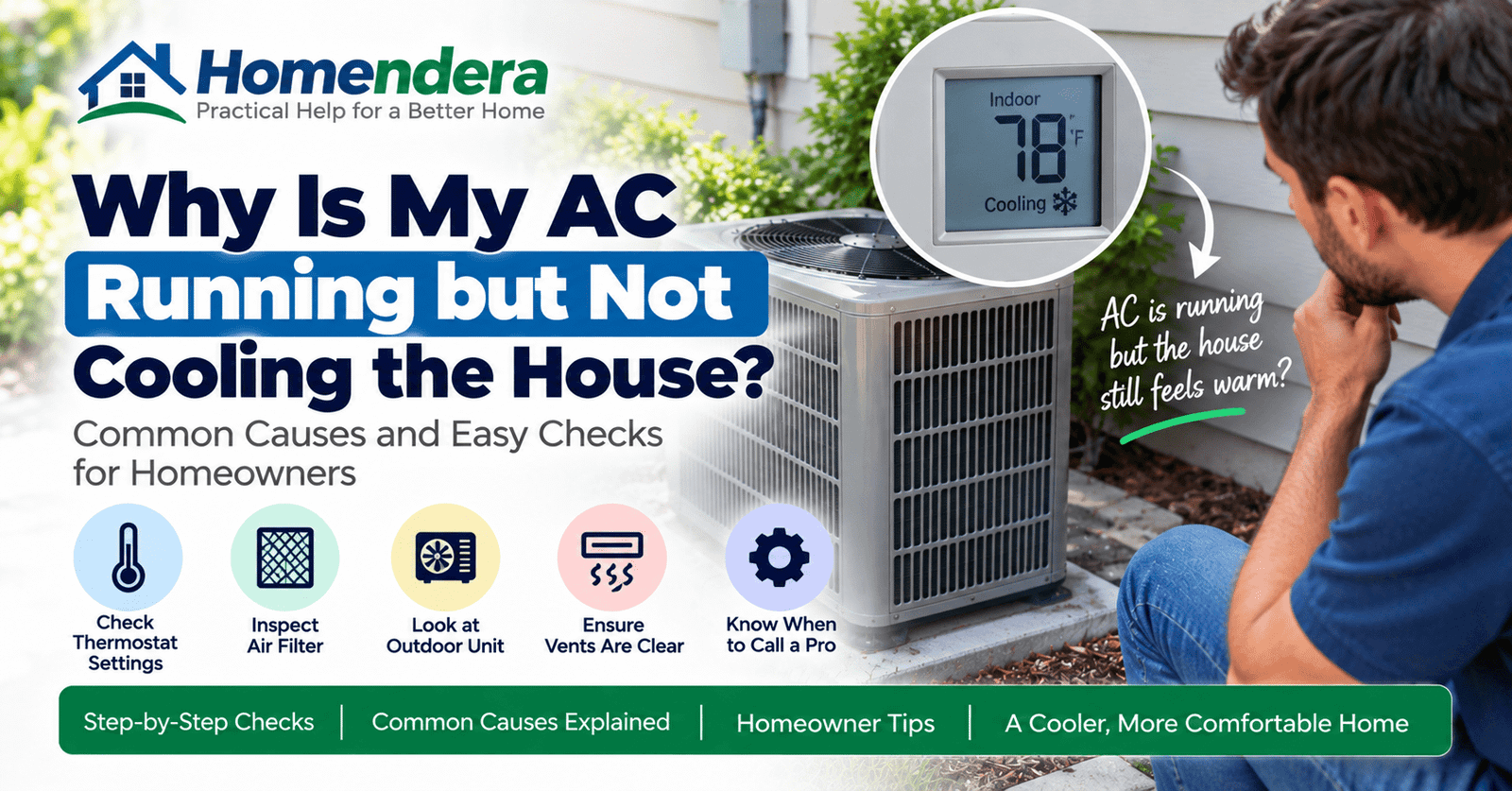
An air conditioner that runs without cooling the house can be frustrating, especially during hot weather. You may hear the system operating normally, yet the indoor temperature barely changes.
Several problems can cause this. Some are simple enough for a homeowner to check, such as an incorrect thermostat setting or a dirty air filter. Others involve refrigerant, electrical components, or internal HVAC parts and should be handled by a qualified technician.
This guide explains what to check when your AC is running but not cooling and when it is better to call a professional.
1. Check the Thermostat Settings First
Start with the simplest possibility: the thermostat.
Make sure it is set to Cool rather than Heat or Fan. Then check that the selected temperature is lower than the current room temperature.
The fan setting also matters. If the thermostat is set to On, the blower may continue running even when the system is not actively cooling. This can make it seem as though the AC is running constantly.
For normal operation, Auto is usually the appropriate fan setting.
If the thermostat display appears unusual or the settings keep changing, the thermostat itself may need further investigation.
If the settings appear correct but the thermostat behaves unexpectedly, see our guide to common thermostat problems for additional troubleshooting steps.
2. Inspect the HVAC Air Filter
A dirty air filter is one of the easiest problems to check.
As dust builds up, airflow through the HVAC system can decrease. Poor airflow may reduce cooling performance and make the system work harder.
Remove the filter according to the system manufacturer’s instructions and inspect it. Replace it if it is visibly dirty or if it has reached its recommended replacement interval.
Our guide on how often you should change your HVAC air filter explains the factors that determine the right replacement schedule.
Do not assume that installing the highest-rated filter available will automatically improve your system. Some HVAC systems require specific filter types or airflow characteristics. Follow the equipment manufacturer’s recommendations.
3. Make Sure Supply Vents Are Open
Walk through the house and inspect the supply vents.
Furniture, rugs, curtains, boxes, and other household items can accidentally block airflow. Also check whether adjustable registers have been closed.
Keep vents reasonably clear so conditioned air can circulate throughout the room.
If one room receives very little airflow while other rooms cool normally, the issue may involve ductwork, dampers, or another part of the distribution system.
4. Check the Return Air Vents
Your HVAC system also needs an unobstructed path for air to return to the equipment.
Look for furniture, curtains, or other objects covering return grilles. Avoid placing large items directly in front of them.
Restricted return airflow can affect system performance.
However, do not remove ductwork or open HVAC equipment simply to investigate an airflow problem. If normal visual checks do not reveal the cause, further diagnosis may require a professional.
5. Look at the Outdoor AC Unit
If your system has an outdoor condenser unit, inspect the area around it from a safe position.
Leaves, grass, weeds, dirt, and other debris can accumulate nearby. These obstructions may interfere with airflow around the equipment.
Keep the surrounding area reasonably clear according to the manufacturer’s instructions.
Do not open electrical panels, remove protective covers, reach inside the unit, or work around moving components. Air-conditioning equipment contains electrical parts that can remain hazardous even when the system appears to be off.
6. Check Whether the Outdoor Unit Is Operating
When cooling is requested, you may be able to observe whether the outdoor unit appears to be operating.
If the indoor blower runs but the outdoor equipment does not appear to operate, the system may have an electrical, control, capacitor, compressor, or other equipment problem.
Avoid trying to diagnose internal electrical components yourself.
A qualified HVAC technician can test the system safely and determine why the outdoor equipment is not operating correctly.
7. Give the System Enough Time to Cool
An air conditioner cannot always reduce indoor temperature immediately.
If the house has become very warm, cooling it may take time. Outdoor temperature, insulation, sunlight, house size, equipment capacity, and indoor heat sources all affect cooling performance.
Instead of repeatedly lowering the thermostat, choose a reasonable setting and observe how the system performs.
Continually setting the thermostat lower does not necessarily make the AC cool faster.
8. Watch for Ice on the System
Ice or frost around accessible refrigerant lines or HVAC components can indicate a problem.
Possible causes include restricted airflow or other system faults. If you notice significant ice, continuing to operate the equipment may not solve the underlying issue.
Do not chip, scrape, or force ice from HVAC components.
A dirty filter is worth checking because restricted airflow can contribute to freezing. If the filter is not the problem, or the system freezes again, arrange professional diagnosis.
9. Consider Whether the Evaporator Coil Is Dirty
The indoor evaporator coil helps absorb heat from indoor air. Dirt buildup can interfere with heat transfer and reduce system performance.
However, accessing and cleaning the coil may require opening HVAC equipment.
That goes beyond the simple maintenance appropriate for many homeowners. If routine filter and airflow checks do not restore cooling, a technician can inspect the coil and determine whether cleaning or another repair is needed.
Regular maintenance can help identify these problems earlier. See our HVAC maintenance checklist for homeowners for routine checks you can perform throughout the year.
If your AC has a frozen evaporator coil, melting ice may also cause water to leak around the indoor unit. See our guide on why your air conditioner is leaking water for additional troubleshooting advice.
10. Check for Signs of a Condensate Drain Problem
Air-conditioning systems remove moisture from indoor air, producing condensation that must drain away.
Depending on the system, a blocked condensate drain or triggered safety switch may interrupt normal cooling operation.
Look for visible warning signs such as:
- Water near indoor HVAC equipment
- An overflowing drain pan
- Unusual moisture around the unit
- Water stains near the equipment
- Repeated system shutdowns
Do not ignore water around HVAC equipment. Moisture can damage nearby materials and may create additional problems.
If you cannot identify a simple, accessible cause, contact an HVAC professional.
11. Think About Recent Power Problems
A power interruption or electrical event can sometimes affect HVAC operation.
For example, the indoor blower might operate while another part of the system does not.
You can check whether other obvious household electrical problems occurred at the same time. However, avoid repeatedly resetting breakers or opening electrical equipment.
A breaker that trips repeatedly indicates a problem that needs investigation.
Electrical diagnosis should be left to an appropriately qualified professional.
12. Refrigerant Problems Need Professional Attention
An air conditioner depends on the correct refrigerant charge to transfer heat effectively.
If refrigerant is leaking or the system charge is incorrect, cooling performance may decline. Possible signs can include poor cooling, unusually long operating cycles, or ice formation.
Refrigerant is not something homeowners should add as a routine DIY fix.
The system should be inspected for the underlying cause. Depending on the equipment and local requirements, refrigerant work may also need to be performed by a licensed or certified technician.
13. Your AC May Be Struggling With Extreme Heat
Sometimes the system is cooling, but it cannot maintain the thermostat setting during unusually hot conditions.
Several factors can contribute:
- Strong direct sunlight
- Poor insulation
- Air leaks
- High indoor heat loads
- Dirty HVAC components
- Inadequate equipment capacity
- Aging equipment
Compare the indoor temperature over time rather than judging performance only by how cool the air feels at a vent.
If cooling performance has suddenly become much worse than it was under similar weather conditions, there may be an equipment or maintenance problem.
14. Check Windows and Doors
Cooling problems do not always begin with the AC itself.
Open windows, damaged weatherstripping, poorly sealed doors, and other air leaks can allow heat into the house while cooled air escapes.
Walk around the home and make sure exterior windows and doors are properly closed.
Also look for obvious deterioration around seals. Addressing simple air leaks can reduce unnecessary demand on the cooling system.
If your air conditioner is running but the vents are producing warm or room-temperature air, read our guide on why your AC is blowing warm air for common causes involving the thermostat, outdoor unit, airflow, and cooling components.
15. Do Not Keep Lowering the Thermostat
When the house feels warm, it is tempting to keep lowering the thermostat.
This usually does not correct the underlying problem.
If the AC cannot reach 24°C (75°F), setting the thermostat to 18°C (64°F) will not repair a dirty filter, refrigerant problem, blocked airflow, or failing component.
Instead, investigate why the system is not cooling as expected.
When Should You Call an HVAC Professional?
Basic homeowner checks are useful, but HVAC systems contain electrical, mechanical, and refrigerant components that require appropriate training.
Consider professional service if:
- The outdoor unit does not operate
- The system repeatedly trips a breaker
- Ice returns after checking the filter
- Water repeatedly collects around the equipment
- Airflow remains unusually weak
- The AC runs continuously without adequate cooling
- You suspect a refrigerant leak
- You notice burning smells or unusual electrical symptoms
- The system makes new or severe noises
- Basic thermostat, filter, and airflow checks do not solve the problem
Turn the system off and seek appropriate help if you notice signs of overheating, smoke, burning odors, or another immediate electrical hazard.
A Simple Troubleshooting Order
When your AC runs but the house remains warm, avoid changing several things at once.
A practical order is:
- Confirm the thermostat is set correctly.
- Inspect the air filter.
- Check supply and return vents.
- Look for obvious airflow obstructions.
- Visually inspect the outdoor unit from a safe position.
- Look for ice or unusual moisture.
- Consider whether the problem started after a power interruption.
- Arrange professional service if normal homeowner checks do not identify the cause.
This approach can help you rule out simple problems without unnecessarily opening or dismantling HVAC equipment.
Final Thoughts
If your AC is running but not cooling the house, begin with simple checks. Confirm the thermostat settings, inspect the filter, make sure vents are open, and look for obvious airflow problems.
Regular maintenance also matters. A clean filter and routine inspection can help the system operate more effectively and make developing problems easier to notice.
Still, not every cooling problem is a DIY repair. Refrigerant issues, electrical faults, compressor problems, and internal HVAC repairs require suitable expertise. Knowing when to stop troubleshooting is an important part of maintaining your home safely.