
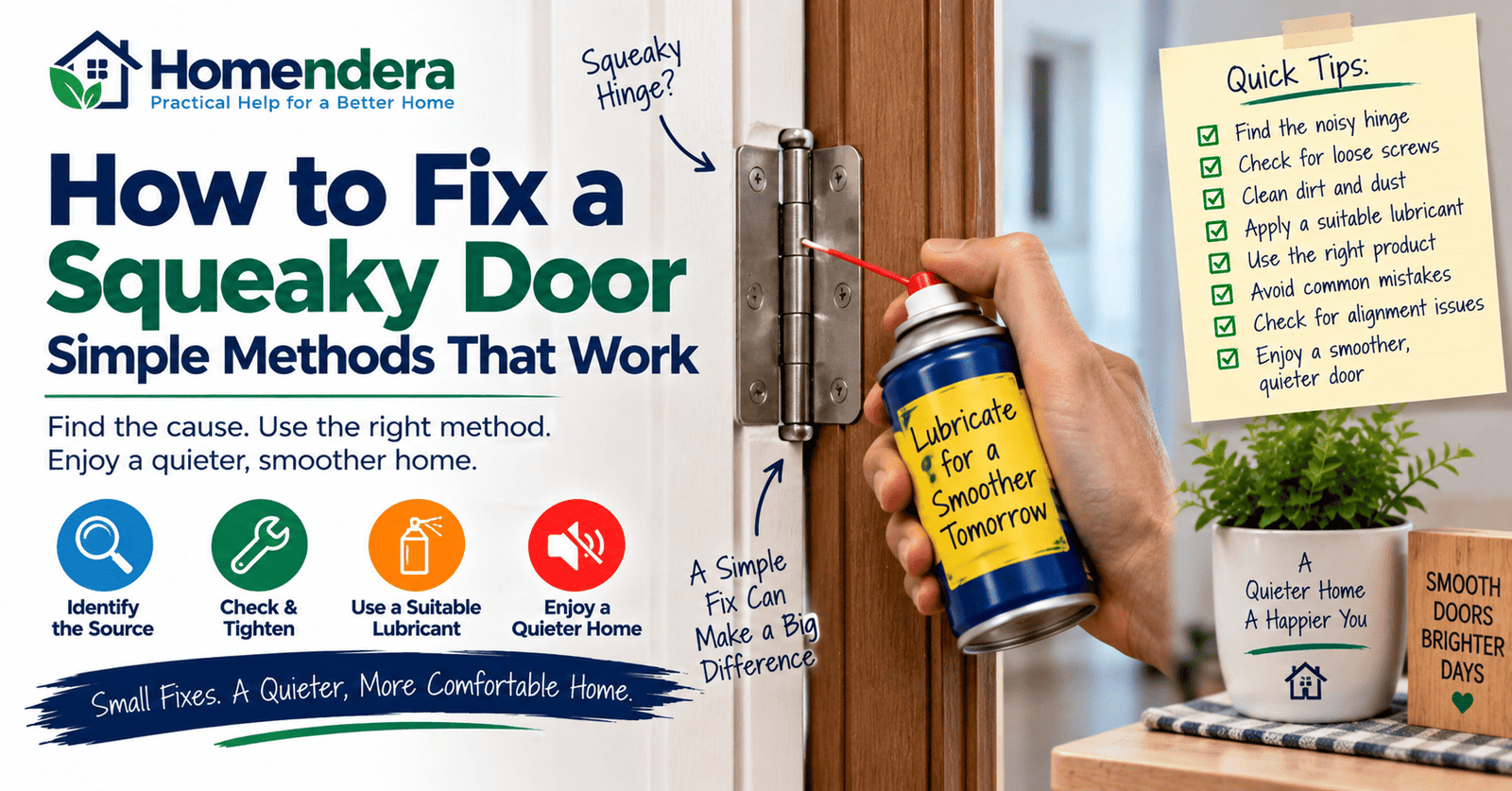
A squeaky door can turn an otherwise quiet room into a daily annoyance. Fortunately, the cause is often relatively simple.
In many cases, the sound comes from friction around the hinges. Loose hardware, dirt, worn hinge components, or a lack of suitable lubrication can all contribute.
Learning how to fix a squeaky door starts with identifying where the noise comes from rather than immediately applying lubricant everywhere. This guide walks through simple homeowner-level checks and explains what to do if the squeak points to a larger door problem.
For more manageable household fixes, see our Basic DIY Home Repairs Every Homeowner Should Know guide.
Why Does a Door Squeak?
A door hinge contains moving metal surfaces. As the door opens and closes, those parts move against each other.
Over time, several things can cause noise.
Common reasons include:
- Dry hinge components
- Dust or dirt around the hinge
- Loose hinge screws
- A dirty hinge pin
- Minor corrosion
- Hinge wear
- Door misalignment
- Excess pressure on one hinge
A squeak alone is usually different from a door that sticks, drags, or will not close correctly.
That distinction matters because lubrication may silence friction without correcting an alignment problem.
Find Which Hinge Is Squeaking
Before reaching for any tools, open and close the door slowly several times.
Listen closely.
Try to determine whether the sound comes from the top, middle, or bottom hinge.
You can repeat the movement while standing near each hinge. Sometimes the source becomes obvious when the door moves slowly.
Do not assume every hinge needs attention simply because one is noisy.
Identifying the source makes the repair cleaner and easier.
Inspect the Hinges
Once you locate the likely source, look closely at the hinge.
Check for:
- Loose screws
- Visible dirt
- Rust or corrosion
- A hinge pin that has moved upward
- Bent components
- Unusual gaps
- Movement between the hinge and door or frame
Also observe how the door sits in its frame.
If the gap around the door looks significantly uneven, or the door rubs against the frame, the squeak may be only one symptom of a larger alignment issue.
Start by Checking Loose Screws
Loose hinge screws can allow unnecessary movement.
Use the correct screwdriver to check accessible screws carefully.
Tighten a loose screw until it is secure, but avoid excessive force.
Overtightening can strip the screw hole or damage the surrounding material.
After checking the screws, open and close the door again.
If the squeak has disappeared, you may not need to do anything else.
What If a Hinge Screw Will Not Tighten?
A screw that keeps turning without becoming secure may no longer have enough material to grip properly.
Repeatedly tightening it harder will not solve that problem.
The appropriate repair depends on the door, frame material, screw location, and extent of damage.
Avoid installing a much longer screw without considering what may be behind the frame. Walls can contain wiring, plumbing, and other concealed services.
If you are uncertain about the construction or the correct repair, stop before creating additional damage.
Lubricate the Squeaky Hinge
If the hinge is secure but still squeaks, lubrication may help.
Choose a lubricant suitable for door hinges and follow the product manufacturer’s instructions.
Use a controlled amount.
More lubricant is not necessarily better. Excess product can drip onto the door, frame, flooring, or surrounding finishes and may attract dust.
Apply it to the relevant moving parts according to the product directions.
Then open and close the door several times to help distribute it through the hinge.
Wipe away excess lubricant with an appropriate cloth.
Which Lubricant Should You Use?
Several products may be suitable for hinge lubrication, depending on the hinge and environment.
Instead of choosing a product simply because it is already in the garage, check whether its manufacturer recommends it for the application.
A good hinge lubricant should be appropriate for the materials involved and the conditions where the door is installed.
Interior and exterior hinges may face different conditions.
Avoid household improvisations that can become sticky, damage finishes, create odors, or attract dirt.
Using a product designed for the task is generally the better approach.
Should You Remove the Hinge Pin?
Often, you do not need to.
Start with the least invasive method: inspect the hinge, tighten loose hardware, and apply an appropriate lubricant if needed.
If the squeak continues and the hinge design permits safe pin removal, cleaning and lubricating the pin may help.
However, removing a hinge pin requires more care because the hinge helps support the door.
Heavy doors can shift unexpectedly.
If you are uncomfortable supporting or working around the door, do not remove the pin.
How to Clean a Removable Hinge Pin
If the hinge pin is designed to be removed and you can do so safely, support the door appropriately before proceeding.
Work on one hinge at a time rather than dismantling several hinges.
Carefully remove the pin using an appropriate method for that hinge design.
Inspect it for dirt, residue, or corrosion.
Clean the pin with a suitable material or product that will not damage it. Once clean and dry as appropriate, apply a suitable lubricant according to its instructions.
Reinstall the pin fully.
Then open and close the door several times and listen for the squeak.
Do Not Remove All the Hinge Pins at Once
This is an unnecessary risk.
The hinges support the door, and some doors are surprisingly heavy.
Removing several pins can allow the door to shift, fall, damage the frame, or cause an injury.
If hinge-pin removal is needed, deal with one hinge at a time while keeping the door appropriately supported.
For heavy, unusual, damaged, or difficult doors, professional assistance may be the safer choice.
What If the Squeak Comes Back?
A squeak that quickly returns may indicate that lubrication alone did not address the cause.
Inspect the hinge again.
Look for:
- Loose screws
- Worn hinge components
- Corrosion
- Bent hardware
- Door sagging
- Misalignment
- Excessive pressure on one hinge
Repeatedly spraying more lubricant may temporarily hide the sound without solving the underlying problem.
A recurring squeak deserves another look.
Check Whether the Door Is Sagging
Stand back and examine the gaps around the door.
They do not always need to be perfectly identical, but obvious changes can provide clues.
A sagging door may place additional stress on certain hinges.
You may also notice that the door:
- Rubs against the frame
- Scrapes the floor
- Needs lifting to close
- Has difficulty latching
- Shows uneven gaps
- Moves when hinge screws are loose
In this situation, treating only the squeak may not be enough.
If the door also sticks, rubs, or refuses to latch, see our guide on how to fix a door that won’t close properly.
Check for Rust or Corrosion
Exterior doors, humid areas, and older hardware may develop corrosion.
Minor surface changes and significant hinge deterioration are not the same thing.
If the hinge is badly corroded, damaged, or no longer moving properly, replacement may be more appropriate than repeatedly lubricating it.
Match replacement hardware to the door and its requirements.
Heavy doors, exterior security doors, fire-rated assemblies, and specialized doors may require particular hardware and installation methods.
What If the Hinge Is Bent?
A visibly bent hinge can affect how the door moves.
Do not repeatedly force the door through its normal range if hardware is clearly damaged.
Depending on the door, replacing the appropriate hinge may be preferable to attempting to bend damaged hardware back into shape.
The replacement should suit the door’s size, weight, location, and intended use.
If several hinges or the frame appear distorted, investigate why before simply replacing one component.
Avoid These Common Squeaky Door Mistakes
A simple repair can become messy when the diagnosis is skipped.
Common mistakes include:
- Lubricating every hinge without locating the noise
- Applying excessive lubricant
- Ignoring loose screws
- Overtightening hinge screws
- Using unsuitable household products as lubricants
- Removing several hinge pins simultaneously
- Ignoring visible corrosion
- Treating a sagging door as only a squeak
- Forcing a door that rubs against the frame
Start with observation and make the smallest appropriate correction first.
That principle applies to many basic DIY home repairs, not just doors.
Protect the Door and Floor While Working
Lubricants can drip.
Before applying one, protect nearby flooring and finishes where appropriate.
Keep a cloth ready to catch excess product.
If the door is painted or finished, make sure the lubricant or cleaner you use is compatible with the surface.
Clean accidental spills according to the product manufacturer’s instructions.
A five-minute hinge repair should not create a permanent stain on the floor.
When a Squeaky Door Is More Than a Squeak
Sometimes the noise appears alongside other changes.
Pay closer attention if the door suddenly begins squeaking while also becoming difficult to operate.
Warning signs can include:
- Significant new gaps
- Cracks around the frame
- Repeated hinge loosening
- Visible frame movement
- Door sagging
- Severe rubbing
- Difficulty locking or latching
- Water damage around the frame
These symptoms do not automatically mean there is a serious structural problem.
However, they provide a reason to investigate rather than repeatedly lubricating the hinges.
Should You Replace the Hinge?
Replacement may make sense when a hinge is badly worn, bent, broken, or significantly corroded.
Before buying new hardware, identify the existing hinge dimensions, type, screw pattern, door requirements, and finish if appearance matters.
Do not assume every hinge of roughly the same size is interchangeable.
Doors with unusual weight, security requirements, fire ratings, or specialized construction may require specific hardware.
How to Prevent Door Hinges From Squeaking
You cannot prevent every squeak, but occasional observation helps.
During normal home maintenance:
- Check for loose hinge screws.
- Keep hinges reasonably clean.
- Watch for corrosion.
- Notice changes in door alignment.
- Address rubbing or sagging rather than forcing the door.
- Use appropriate lubrication when needed.
There is no need to lubricate every hinge on a rigid calendar if it is operating quietly and the manufacturer does not require it.
Maintenance should respond to the actual hardware and conditions in your home.
Add Doors to Your Home Maintenance Routine
Doors are easy to overlook until they stop working properly.
Our Monthly Home Maintenance Checklist recommends periodically opening and closing frequently used doors and windows to notice changes.
This takes very little time and can reveal loose hardware, sticking, damaged seals, or alignment changes early.
When Should You Call a Professional?
A basic squeaky hinge usually does not require professional help.
However, assistance may be appropriate when:
- The door is extremely heavy
- The frame appears damaged
- Hinges repeatedly pull away
- The door has significant alignment problems
- Structural movement is suspected
- Security hardware no longer operates properly
- A specialized or fire-rated door is involved
- You cannot safely support the door
- The problem continues despite appropriate basic maintenance
The aim of DIY is not to avoid professional help at all costs.
It is to handle suitable repairs safely while recognizing when a problem requires more expertise.
Final Thoughts
Learning how to fix a squeaky door is a useful entry-level DIY skill.
Start by finding the noisy hinge. Check the hardware, tighten loose screws carefully, and use an appropriate lubricant when needed.
If the noise continues, inspect the hinge for dirt, wear, corrosion, or damage.
Most importantly, pay attention to how the entire door operates. A squeak accompanied by sagging, rubbing, large gaps, or difficulty closing may indicate that the hinge noise is only part of the problem.
Diagnose first, make the simplest appropriate repair, and stop when the job moves beyond safe homeowner-level maintenance.