
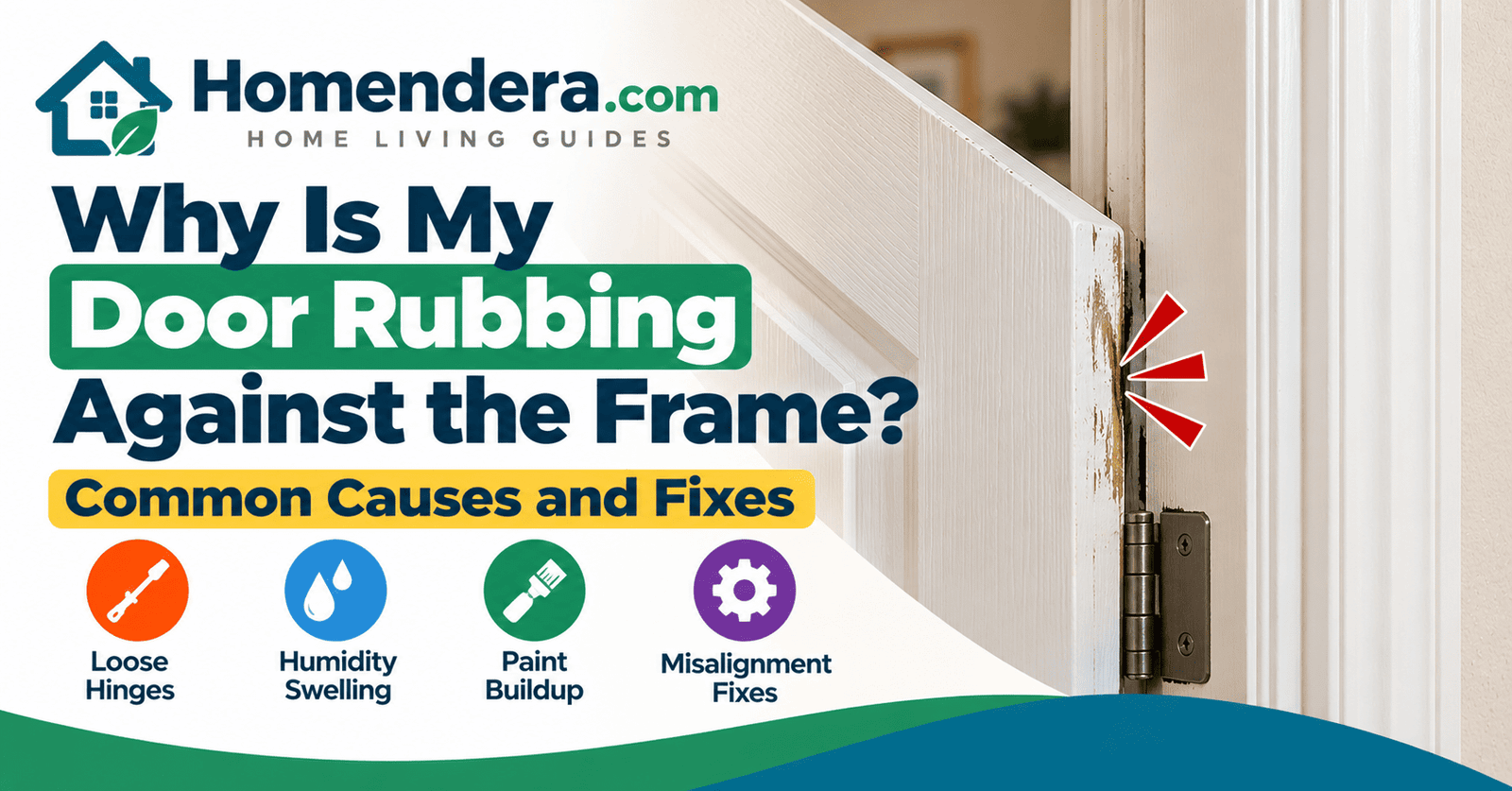
A door rubbing against the frame can make everyday use frustrating. You may hear a scraping sound when opening or closing it, notice paint wearing away along the edge, or find that the door needs an extra push to shut properly. In some cases, the problem appears suddenly. In others, the rubbing becomes worse over several weeks or months.
A door can rub against its frame for several reasons. Loose hinges, changes in humidity, a shifting door frame, or an uneven installation may affect how the door fits inside the opening.
Fortunately, some problems are relatively simple to identify. For example, loose hinge screws or a small buildup of paint may cause minor rubbing. However, a badly misaligned frame, damaged hardware, or signs of structural movement may require professional attention.
This guide explains how to find the contact point, understand the likely causes, and choose a safe repair without making the problem worse.
Why Does a Door Rub Against Its Frame?
A door should move smoothly through its opening without scraping against the surrounding frame.
The small gaps around its edges allow it to open, close, and latch properly.
When those gaps become uneven or too narrow, the door may touch the frame.
Common causes include:
- Loose or worn door hinges
- A door that has dropped slightly
- Changes in indoor humidity
- Swollen or warped wood
- Thick paint buildup
- Incorrectly installed hinges
- A misaligned door frame
- Loose or damaged hinge screws
- Changes in the building structure
- A door that was installed incorrectly
The location of the rubbing often provides the most useful clue.
Where Is Your Door Rubbing?
Before attempting any repair, determine exactly where the door touches the frame.
| Rubbing Location | Possible Cause |
|---|---|
| Top corner near the latch | Door sagging or hinge misalignment |
| Top edge | Frame movement, swelling, or installation issue |
| Side near the hinges | Hinge alignment or insufficient clearance |
| Side near the latch | Swollen door, frame misalignment, or paint buildup |
| Bottom edge | Floor clearance, swelling, or a dropped door |
| Several edges | Warped door, distorted frame, or installation problem |
These are possible explanations rather than definite diagnoses.
A careful inspection is necessary before deciding what to adjust.
1. Loose Door Hinges
Loose hinges are a common reason a door begins rubbing against its frame.
Each hinge helps support the door and maintain its position.
When hinge screws loosen, the door may shift slightly.
Even a small change can reduce the clearance around the edges.
Signs of loose hinges
- The door rubs near the upper latch-side corner.
- The door appears slightly tilted.
- There is an uneven gap along the top.
- A hinge plate visibly moves.
- The door makes a scraping sound when closing.
What can you do?
Open the door and inspect the visible hinges.
Look for loose or missing screws, damaged plates, and unusual movement.
If the manufacturer permits it and the screws are accessible, carefully tighten loose screws using the correct screwdriver.
Avoid overtightening, which can damage the screw holes or hardware.
Do not remove hinge screws while the door is unsupported.
Heavy doors, fire-rated doors, and doors with damaged hinges may need professional repair.
For related guidance, see our article on how to fix a squeaky door, which explains common hinge-related problems.
If the hinge plate moves or the screws no longer hold securely, read our guide on how to fix a loose door hinge for common causes and safe repair options.
2. The Door Has Dropped Slightly
A door may gradually sag because of hinge wear, loose fasteners, or damage to the supporting material.
When this happens, the door no longer sits squarely inside the frame.
The upper corner on the latch side may move closer to the frame.
The bottom edge may also begin rubbing against the floor.
Warning signs
- Uneven gaps around the door
- Scraping near the upper latch-side corner
- Difficulty aligning the latch
- Visible hinge movement
- A door that no longer hangs straight
How should you handle it?
Start by checking the hinges for visible looseness or damage.
Do not lift or force the door while tightening hardware.
If the screws no longer hold securely, the supporting wood or hinge attachment may need repair.
A carpenter or qualified door installer can assess the problem and restore proper alignment.
3. Wood Swelling Due to Humidity
Wood naturally responds to changes in moisture.
When humidity increases, wooden doors may absorb moisture and expand.
This can reduce the gap between the door and frame.
As a result, a door that worked normally during dry weather may begin sticking or rubbing during humid periods.
Signs of moisture-related swelling
- The door rubs more during humid weather.
- The problem becomes worse after heavy rain.
- The door edge looks swollen.
- Paint begins peeling or cracking.
- The wood feels damp.
- The door returns closer to normal during drier conditions.
What should you do?
Check for signs of moisture around the door, frame, and nearby walls.
Improve indoor humidity control where appropriate.
Look for plumbing leaks, rainwater intrusion, or condensation.
Avoid sanding or cutting a swollen door before identifying the moisture source.
Otherwise, the door may become too loose when it dries.
Our guide on signs of excess moisture in your home explains how to recognize moisture-related problems before they cause further damage.
4. Paint Buildup Along the Door Edge
Repeated painting can gradually reduce the clearance around a door.
Several layers of paint may accumulate on the door edge, frame, or door stop.
Eventually, the surfaces may begin touching.
Signs of paint-related rubbing
- Scraping occurs along a painted edge.
- Paint transfers from one surface to another.
- The problem started after repainting.
- The door feels sticky rather than noticeably misaligned.
- Thick paint is visible near the contact point.
What can you do?
Inspect the painted surfaces for obvious buildup.
If the paint is still curing, follow the manufacturer’s drying and curing instructions.
Do not force the door closed while the paint remains tacky.
For older paint, take precautions before sanding or scraping. Paint in older homes may contain lead or other hazardous materials.
If you suspect lead-based paint, avoid disturbing it and seek appropriate professional guidance.
5. The Door Frame Is Out of Alignment
Sometimes the problem is not the door itself.
The surrounding frame may be uneven or distorted.
A misaligned frame can create narrow gaps along one or more edges.
Possible causes
- Poor original installation
- Moisture damage
- Movement in surrounding materials
- Loose frame components
- Changes in the building structure
Warning signs
- Several edges rub at once.
- The gap changes noticeably from top to bottom.
- The frame looks twisted.
- Cracks appear around the doorway.
- The problem continues despite sound hinges.
What should you do?
Inspect the frame visually.
Look for obvious gaps, damaged trim, and signs of moisture.
Avoid forcing the door or attempting major frame adjustments without understanding the cause.
If the doorway appears distorted or nearby cracks are increasing, seek professional assessment.
6. Worn or Damaged Hinges
Door hinges can wear out over time.
Their moving parts may loosen, bend, or become damaged.
A worn hinge may no longer hold the door in its intended position.
Common symptoms
- The door hangs unevenly.
- A hinge appears bent.
- The door moves abnormally around the hinge.
- Screws repeatedly loosen.
- The door rubs despite minor adjustments.
Should you replace the hinge?
A damaged hinge may need replacement with a compatible component.
However, replacing hinges can involve supporting and aligning the door.
This may be difficult or unsafe with heavy doors.
If the hinge is visibly bent, cracked, or pulling away from the frame, professional assistance is recommended.
7. A Warped Door
A warped door no longer maintains its original flat shape.
Wooden doors may warp because of uneven moisture exposure, temperature changes, or manufacturing and installation conditions.
Signs of a warped door
- The door rubs in several places.
- One corner sticks out farther than the others.
- The door appears twisted.
- The door does not sit evenly against the stop.
- The problem continues even when the hinges appear secure.
What should you do?
Inspect the door from different angles.
Look for visible twisting, bending, or uneven surfaces.
Do not attempt to force the door back into shape.
Depending on the severity, professional adjustment or replacement may be necessary.
8. Incorrect Hinge Installation
Hinges must be positioned correctly to allow the door to move through its opening.
If a hinge is installed at the wrong depth or angle, the door may sit too close to the frame.
Signs of installation problems
- The rubbing began immediately after installation.
- The door has never moved smoothly.
- One hinge looks different from the others.
- The door edge contacts the frame throughout its movement.
- The gaps are uneven.
If the problem began after a hinge replacement, check whether the correct hardware was used.
Avoid modifying hinge recesses or removing material without suitable experience.
An installer can determine whether the hinges need repositioning.
9. The Door Is Rubbing at the Top
A door that rubs along the top edge may have insufficient clearance.
Possible causes include:
- A door that has shifted upward or tilted
- Frame misalignment
- Wood swelling
- Incorrect installation
- Paint buildup
How to identify the problem
Close the door slowly without forcing it.
Observe where the top edge approaches the frame.
Look for uneven gaps and visible contact marks.
If the top corner near the latch rubs while the hinge-side gap remains wider, hinge alignment may be involved.
However, the exact cause depends on the door’s position and condition.
10. The Door Is Rubbing on the Hinge Side
Rubbing near the hinges can happen when the door sits too close to the frame.
This may result from incorrect hinge positioning, damaged hardware, or insufficient clearance.
What to check
- Visible hinge alignment
- Loose screws
- Bent hinge plates
- Paint buildup
- Contact marks along the edge
Do not bend hinge plates or remove hinge material without proper guidance.
These adjustments can affect the door’s support and alignment.
11. The Door Is Rubbing on the Latch Side
The latch side is the edge opposite the hinges.
When the door rubs here, possible causes include swelling, sagging, frame movement, or paint buildup.
Common symptoms
- The door needs extra force to close.
- The latch no longer aligns correctly.
- Scrape marks appear near the handle.
- The door sticks near the upper or lower corner.
What should you do?
Inspect the gaps around the door.
Check whether the latch is hitting the strike plate or whether the door edge is actually rubbing against the frame.
These are different problems.
If the latch is the main issue, our guide on how to fix a door that won’t close properly covers related troubleshooting.
12. The Door Is Rubbing at the Bottom
Bottom-edge rubbing can occur when the door drops slightly, swells, or loses clearance above the floor.
However, floor changes can also cause the problem.
Possible causes
- A sagging door
- New carpet or flooring
- Moisture swelling
- An uneven floor
- Incorrect door height
- Damaged hinges
What should you check?
Look for visible marks along the bottom edge.
Notice whether the rubbing started after flooring work.
Check whether the door also appears tilted.
Do not immediately cut or trim the bottom of the door.
Removing material unnecessarily may create a large gap or affect the door’s intended performance.
13. Why Does My Door Rub Only When Closing?
Some doors move freely while opening but begin rubbing during the final part of closing.
Possible causes include:
- Misaligned hinges
- A door that has shifted
- A tight door stop
- Paint buildup
- A warped door
- Frame movement
The direction and timing of the contact can help identify the problem.
Close the door slowly and observe where resistance begins.
Avoid pushing harder to overcome the rubbing.
Forcing the door may damage the frame, hinges, or latch.
14. Why Does My Door Rub After Painting?
Fresh paint can temporarily make a door feel sticky.
However, thick paint layers can also create a lasting clearance problem.
What to check
- Whether the paint has fully cured
- Whether the door was closed before drying
- Whether paint accumulated on the edge
- Whether the frame or door stop was painted heavily
Allow adequate curing time.
If the problem remains, a qualified painter or carpenter can assess whether excess paint needs to be removed.
Take appropriate precautions with older paint.
15. Why Does My Door Rub During Humid Weather?
Humidity can affect wooden doors and frames.
When moisture levels increase, wood may expand.
The resulting reduction in clearance can make the door stick.
Helpful precautions
- Check for water leaks.
- Improve ventilation.
- Monitor indoor humidity.
- Keep exterior weather seals in good condition.
- Address recurring dampness.
If the problem appears alongside window condensation, our guide on why condensation forms on windows explains how humidity affects indoor surfaces.
Do not assume that humidity is the only cause.
A door may also have an underlying alignment problem.
16. Why Does My Door Rub After Installing New Flooring?
New flooring can change the available clearance beneath a door.
Carpet, underlayment, tile, and other materials may raise the finished floor height.
Signs of a flooring-related problem
- The door worked normally before the renovation.
- Rubbing occurs only along the bottom.
- The door touches carpet or a new threshold.
- There is no obvious hinge movement.
What should you do?
Identify whether the contact occurs with the flooring, threshold, or door frame.
Check the flooring manufacturer’s installation requirements.
Avoid trimming a door until the necessary clearance and door type are confirmed.
Fire-rated, exterior, and specialty doors may have important clearance and sealing requirements.
17. How to Find Exactly Where a Door Is Rubbing
Locating the contact point is one of the most useful steps in troubleshooting.
Step 1: Open the door fully
Look for obvious damage, paint marks, or swelling.
Step 2: Close it slowly
Watch where the door approaches the frame.
Do not force it shut.
Step 3: Check the gaps
Compare the clearance along the top and both sides.
Step 4: Look for scrape marks
Worn paint or polished areas may indicate repeated contact.
Step 5: Listen for rubbing
Notice when the scraping begins.
Step 6: Inspect the hinges
Look for visible looseness, damage, or misalignment.
Step 7: Check for moisture
Inspect nearby surfaces for dampness, staining, or swelling.
These observations can help you choose the correct next step.
18. How to Fix a Door Rubbing Against the Frame
The appropriate repair depends on the cause.
Start with the least invasive checks.
Step 1: Identify the rubbing location
Determine whether the door touches the top, bottom, hinge side, or latch side.
Step 2: Inspect the hinges
Look for loose screws, damaged plates, and unusual movement.
Step 3: Check for paint buildup
Identify thick paint layers or sticky surfaces.
Step 4: Look for moisture-related swelling
Check for dampness, water stains, and seasonal changes.
Step 5: Inspect the frame
Look for uneven gaps, distortion, or damaged trim.
Step 6: Address simple maintenance issues
Clean accessible surfaces and carefully tighten permitted user-serviceable hardware where safe.
Step 7: Seek professional help when needed
If the door remains misaligned, the hinges are damaged, or the frame appears distorted, arrange professional assessment.
Do not begin sanding, cutting, or repositioning hinges until the actual cause is understood.
19. Should You Sand a Door That Rubs?
Sanding may sometimes be appropriate for a minor clearance problem.
However, it should not be the first solution.
A door may rub because of loose hinges or temporary moisture swelling.
Removing material without correcting the cause can create uneven gaps.
Before considering sanding
Check:
- Whether the hinges are secure
- Whether the door is swollen
- Whether the frame is aligned
- Whether paint buildup is responsible
- Whether the door is fire-rated or specially sealed
If the door requires material removal, follow the manufacturer’s specifications and use a qualified carpenter where appropriate.
Older paint may require lead-safe precautions.
20. Should You Plane a Door That Rubs?
Planing removes wood from the door edge.
It can provide additional clearance in certain situations.
However, removing too much material may affect the door’s appearance, weather sealing, fire rating, or structural integrity.
Planing is not a suitable solution for every rubbing problem.
If the door is sagging because of loose hinges, correcting the hinge issue may be more appropriate.
A carpenter can determine whether planing is necessary.
21. Can Lubricating the Hinges Stop Door Rubbing?
Lubrication may reduce squeaking or friction inside a hinge.
However, it does not usually correct a door edge that physically rubs against the frame.
If the door is misaligned, lubrication alone will not restore the required clearance.
Use manufacturer-approved products for hinge maintenance.
Avoid applying excessive lubricant to painted or finished surfaces.
For hinge noise, read our guide on how to fix a squeaky door.
22. Can a Loose Door Handle Cause Rubbing?
A loose handle usually does not cause the door itself to rub against the frame.
However, a damaged latch or handle assembly can make closing difficult.
This may feel similar to a rubbing problem.
How to tell the difference
If the door edge scrapes against the frame, the issue is likely related to clearance or alignment.
If the door moves freely but the latch catches, the handle or strike plate may be involved.
Our guide on why your door handle is loose explains common handle-related problems.
23. When Is Door Rubbing a Sign of a Bigger Problem?
Occasional minor rubbing may result from humidity or ordinary hardware wear.
However, some changes deserve closer attention.
Warning signs
- Several doors begin sticking at the same time.
- New cracks appear around doorways.
- Floors become noticeably uneven.
- The frame looks distorted.
- The problem develops suddenly after water damage.
- The door opening changes shape.
- The surrounding wall shows movement.
These symptoms do not automatically mean the building has a structural problem.
However, they may justify inspection by a qualified building professional.
Do not attempt to correct suspected structural movement by cutting or forcing the door.
24. When Should You Call a Carpenter?
Professional assistance is recommended when:
- The door is badly misaligned.
- Hinges are damaged.
- Screws no longer hold securely.
- The frame is warped or distorted.
- The door needs significant material removal.
- A heavy door must be removed.
- The door is fire-rated or has special hardware.
- Moisture damage affects the frame.
- Several repair attempts have failed.
- The cause remains unclear.
A carpenter or experienced door installer can assess the door, hinges, and frame together.
For general advice on deciding whether to attempt a repair yourself, see DIY vs professional repair.
25. How to Prevent Doors From Rubbing Against Frames
Routine maintenance can help prevent some alignment and clearance problems.
Check hinges periodically
Look for loose hardware and visible damage.
Control indoor moisture
Address leaks and excessive humidity promptly.
Avoid slamming doors
Repeated impacts can place stress on hinges and hardware.
Use suitable paint finishes
Avoid excessive paint buildup around moving edges.
Watch for early scraping
Investigate minor rubbing before it becomes more severe.
Maintain exterior weather protection
Keep rainwater from entering vulnerable door and frame materials.
Avoid unnecessary alterations
Do not trim or reshape a door without identifying the cause.
Inspect surrounding surfaces
Notice cracks, dampness, and changes in the frame.
For more preventive tasks, explore our home maintenance checklist for homeowners.
Common Mistakes to Avoid
When fixing a door that rubs against its frame, avoid these mistakes:
- Forcing the door closed
- Sanding before checking the hinges
- Cutting a door that is temporarily swollen
- Overtightening damaged screws
- Bending hinge plates without guidance
- Ignoring moisture damage
- Removing too much material
- Using unsuitable replacement hardware
- Overlooking a distorted frame
- Attempting repairs on heavy doors without proper support
- Modifying fire-rated doors without professional guidance
Identifying the cause first usually leads to a more reliable repair.
Frequently Asked Questions
Why Is My Door Rubbing Against the Frame?
Common causes include loose hinges, door sagging, wood swelling, paint buildup, warped materials, and frame misalignment.
How Do I Stop My Door From Rubbing?
Start by identifying where the door makes contact.
Check the hinges, look for moisture damage, and inspect the frame before considering adjustments.
Why Is My Door Rubbing at the Top?
Possible causes include sagging, hinge misalignment, wood swelling, or changes in the door frame.
Why Is My Door Rubbing on the Side?
The door may be swollen, improperly aligned, or too close to the frame because of hinge positioning or paint buildup.
Can Humidity Make a Door Rub?
Yes. Wooden doors can expand when they absorb moisture, reducing the available clearance.
Should I Sand My Door to Stop It Rubbing?
Not immediately.
First, determine whether loose hinges, swelling, or frame movement are causing the problem.
Can Tightening Hinges Fix a Rubbing Door?
It may help when loose hinge screws have allowed the door to shift.
However, it will not correct every alignment problem.
Why Does My Door Rub Only in Summer?
Seasonal humidity changes may cause wooden doors to expand.
Other factors, including frame movement, may also contribute.
Can a Door Rub Because of Foundation Problems?
Changes in a building’s structure can sometimes affect door openings.
However, most rubbing doors do not automatically indicate foundation damage.
Seek professional assessment if you notice multiple sticking doors, new cracks, or other signs of movement.
When Should I Replace a Door That Rubs?
Replacement may be appropriate when the door is severely warped, damaged, or no longer suitable for its opening.
Many minor rubbing problems can be repaired without replacing the entire door.
Final Thoughts
A door rubbing against its frame is often caused by a small change in alignment, loose hinges, moisture swelling, or paint buildup.
The most useful first step is to identify exactly where the door touches the frame.
From there, inspect the hinges, check for moisture, and look for visible damage.
Avoid cutting, sanding, or forcing the door before understanding the cause.
If the frame is distorted, the door is heavily damaged, or the problem involves structural movement, professional assistance is the safer option.
For more practical household repair advice, explore our guides on how to fix a door that won’t close properly, how to fix a squeaky door, and basic DIY home repairs every homeowner should know.