
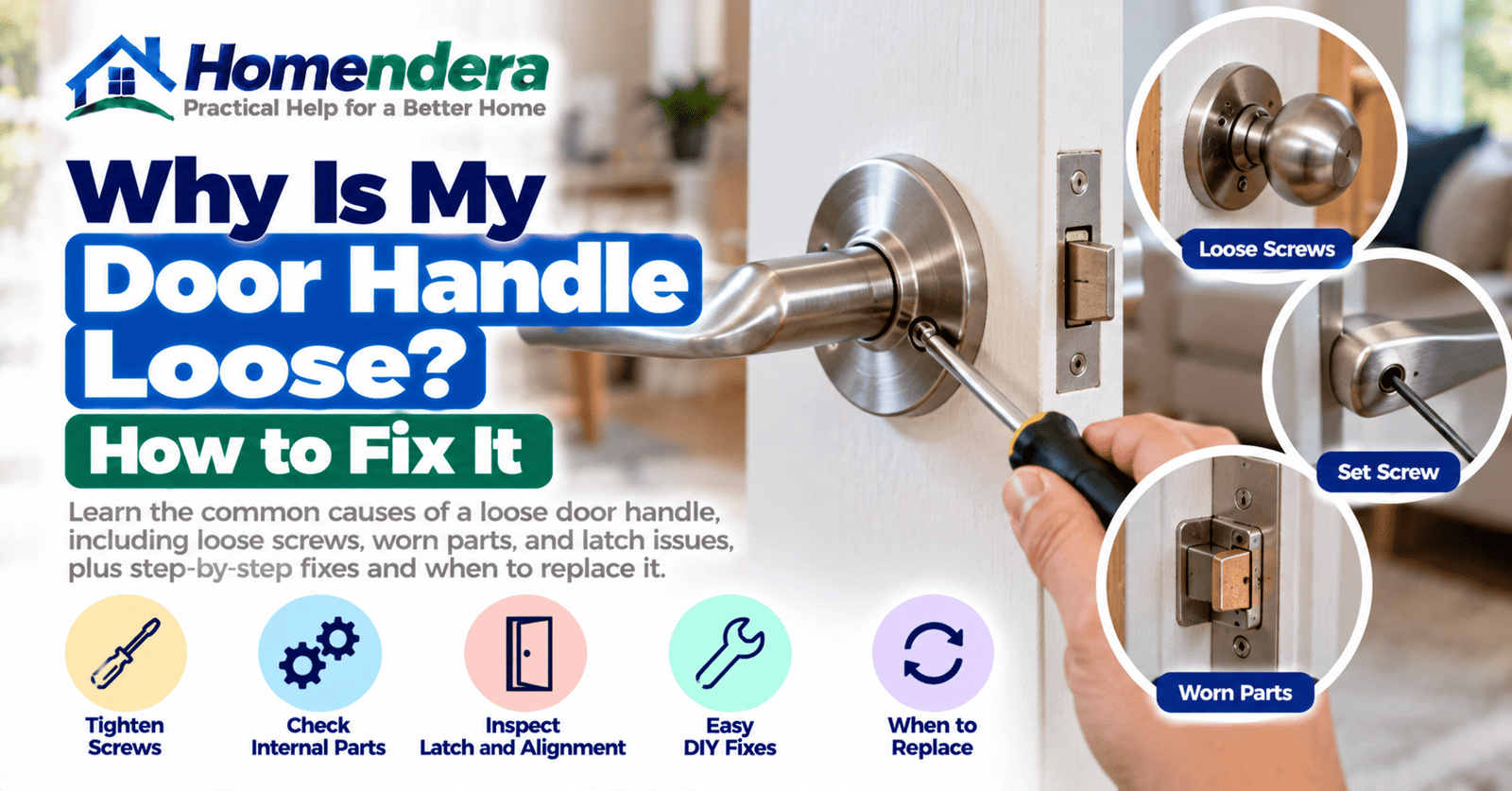
A loose door handle is a common household problem. You may notice the handle wobbling, the knob moving away from the door, or the lever feeling unstable when you open and close it.
In many cases, loose screws or mounting hardware cause the problem. However, worn internal parts, damaged screw holes, or an incorrectly fitted lockset can also make a handle unstable.
If you’re wondering why your door handle is loose, start by identifying the type of handle and checking for visible problems. Some repairs take only a few minutes, while others require replacement parts or professional attention.
This guide explains the common causes, how to fix a loose door handle safely, and when replacing the hardware makes more sense.
Why Do Door Handles Become Loose?
Door handles experience repeated movement throughout the day. Every time someone turns a knob, presses a lever, or pulls a door, the hardware experiences some stress.
Over time, components can loosen or wear.
Common causes include:
- Loose mounting screws
- Hidden set screws becoming loose
- Worn handle mechanisms
- Stripped screw holes
- Damaged mounting plates
- Incorrect installation
- Loose decorative covers
- Worn spindles or internal connections
- Door misalignment
- Damaged or low-quality hardware
The right repair depends on which component is moving.
1. Identify What Is Actually Loose
Before reaching for a screwdriver, examine the handle carefully.
Try to determine whether:
- The entire handle assembly moves
- Only the lever or knob wobbles
- The decorative cover moves
- The handle turns without operating the latch
- The handle pulls away from the door
- The screws no longer tighten properly
These symptoms point toward different problems.
For example, a loose decorative cover may need a simple adjustment. A handle that turns without moving the latch may have a damaged internal component.
2. Check the Visible Mounting Screws
Many traditional door knobs have visible screws on the interior side of the door.
These screws secure the two sides of the handle assembly.
If they loosen, the entire handle may wobble.
How to tighten them
- Open the door so you can access both sides.
- Locate the mounting screws.
- Choose a screwdriver that fits correctly.
- Tighten each screw gradually.
- Alternate between screws to keep the assembly aligned.
- Test the handle.
Avoid overtightening. Excessive force can strip threads, damage the mounting plate, or interfere with the mechanism.
If the handle becomes firm and operates normally, the repair may be complete.
3. Look for Hidden Screws
Some modern door handles have no visible mounting screws.
Instead, they use concealed fasteners behind a decorative cover, sometimes called a rosette.
Look around the base of the handle for a small notch, opening, or removable trim piece.
The exact design varies by manufacturer.
Some covers twist off, while others release through a small opening.
Do not force a cover without identifying how it attaches.
4. Remove a Decorative Cover Carefully
If the manufacturer’s design allows removal, you may be able to access the mounting screws behind the cover.
First, examine the cover for a release notch or retaining mechanism.
Use the recommended tool where possible.
Protect the door finish and surrounding paint.
Once the cover is removed, inspect the mounting screws and tighten them carefully.
Then reinstall the cover and confirm that it sits securely.
5. Check the Set Screw on a Lever Handle
Some lever handles use a small set screw to secure the lever to a spindle.
The screw may be located underneath the lever or near its base.
If it loosens, the lever can wobble or slide outward.
What to do
- Locate the set screw.
- Identify the correct screwdriver or hex key.
- Check that the lever is seated properly.
- Tighten the screw gently.
- Test the handle.
Do not substitute an incorrectly sized tool. Small set screws are easy to damage.
If the screw repeatedly loosens, the screw or connection may be worn.
6. Check Whether the Handle Is Properly Seated
Sometimes the handle itself has shifted away from its intended position.
A lever may no longer sit fully on the spindle, or the handle assembly may have moved slightly away from the door.
Check for an unusual gap between the handle and its mounting surface.
If the design allows adjustment, reseat the component according to the manufacturer’s instructions before tightening its fastener.
Do not force a handle into position if it appears bent or damaged.
7. Inspect the Decorative Rosette
The rosette is the round or rectangular plate surrounding many door handles.
It may be decorative, structural, or both, depending on the hardware design.
A loose rosette can make the handle look unstable even when the operating mechanism remains secure.
Check whether the plate itself moves.
If the cover is simply loose, reinstall it according to its attachment method.
If the mounting plate underneath moves, inspect its fasteners.
8. Check for Stripped Screw Holes
A screw that keeps turning without becoming tight may have damaged threads or a stripped mounting hole.
The repair depends on the hardware design and what the screw attaches to.
For example:
- A machine screw may have damaged threads.
- A mounting post may be worn.
- A wood screw may no longer grip the door material.
- A mounting plate may be damaged.
Do not assume every stripped hole can be repaired by inserting wood filler or a larger screw.
Modern locksets often use machine screws and threaded mounting posts that require compatible replacement parts.
9. What If the Screws Keep Coming Loose?
Repeatedly tightening the same screws is not always a lasting solution.
Possible causes include:
- Worn threads
- Damaged mounting posts
- Incorrect screw length
- Misaligned hardware
- Excessive movement
- Poor installation
- Internal wear
Inspect the hardware rather than simply applying more force.
If a screw or mounting component is damaged, replace it with a compatible part.
10. Check the Spindle
The spindle connects the handle to the latch mechanism in many door-handle designs.
When you turn or press the handle, the spindle transfers that movement to the latch.
A worn or damaged spindle may cause:
- Excessive handle movement
- Delayed latch operation
- A handle that turns without retracting the latch
- Uneven operation between the two sides
Spindle designs vary.
If the connection appears damaged, consult the manufacturer’s instructions or consider replacing the affected hardware.
11. Inspect the Latch Operation
A loose handle may be accompanied by a latch that does not work properly.
With the door open, operate the handle and watch the latch.
It should move smoothly and return to its normal position.
Look for:
- Sticking
- Incomplete retraction
- Unusual resistance
- Delayed movement
- A handle that fails to operate the latch
Do not close the door to test a questionable latch until you are confident it will reopen reliably.
12. Check Whether the Door Is Misaligned
Sometimes the handle is not the original problem.
A door that rubs against its frame or requires excessive force to close can place additional stress on its hardware.
Check whether the latch meets the strike plate correctly.
Look for uneven gaps around the door.
Our guide on how to fix a door that won’t close properly explains common hinge, alignment, and strike-plate problems.
Correcting door alignment may help prevent the handle from loosening again.
13. Avoid Slamming or Forcing the Door
Repeated slamming can place unnecessary stress on handles, latches, hinges, and frames.
A door should generally close and latch without excessive force.
If you need to lift the door, push hard, or repeatedly pull the handle to make it close, investigate the underlying issue.
Replacing the handle alone may not solve the problem.
14. Loose Door Knob vs Loose Lever Handle
Door knobs and lever handles often share similar mounting principles, but their designs can differ.
| Door knob | Lever handle |
|---|---|
| May have visible or concealed mounting screws | May use a small set screw |
| Can wobble around its base | Can sag or move outward |
| May contain a removable knob mechanism | May connect through a separate spindle |
| Often uses a round decorative plate | May use a round or rectangular rosette |
Always inspect the actual hardware rather than assuming every handle comes apart the same way.
15. What If the Door Handle Is Sagging?
A lever that hangs downward instead of returning to its normal position may have a problem with its return spring or internal mechanism.
Tightening the mounting screws may not correct this.
Some handle sets have replaceable spring components, while others require a larger replacement assembly.
Check the manufacturer’s documentation.
Do not continue forcing a handle that no longer operates the latch reliably.
16. What If the Handle Turns but the Door Won’t Open?
This may indicate a more serious problem than loose mounting screws.
Possible causes include:
- A disconnected spindle
- A worn internal connection
- A damaged latch mechanism
- A failed handle assembly
If the door is open, keep it open while investigating.
If the door is closed and cannot be opened normally, a locksmith or qualified repair professional may be necessary.
Avoid damaging the door or frame through unnecessary force.
17. Check for Corrosion or Rust
Door handles in damp areas may develop corrosion.
This can affect screws, internal connections, and moving components.
Inspect accessible surfaces for:
- Rust
- Discoloration
- Pitting
- Stiff movement
- Deteriorated fasteners
Minor surface cleaning may help with appearance, but damaged internal components may need replacement.
If moisture is affecting nearby building materials, our guide on signs of excess moisture in your home explains other warning signs worth checking.
18. Be Careful With Lubricants
A stiff or noisy handle does not automatically need lubricant.
Some locksets contain components that require particular products or should not be lubricated by homeowners.
Avoid spraying general-purpose oil indiscriminately into the handle or lock mechanism.
Excess lubricant can attract dirt or affect certain materials.
Use only products recommended by the hardware manufacturer.
19. Should You Remove the Entire Door Handle?
Not every loose handle requires complete removal.
Start with the least invasive checks.
For example:
- Inspect visible screws.
- Check the set screw if present.
- Examine the decorative cover.
- Test the latch.
- Check whether the handle is seated properly.
If the problem remains, consult the manufacturer’s disassembly instructions.
Taking apart unfamiliar hardware unnecessarily can make reassembly more difficult.
20. How to Remove a Door Handle Safely
If removal is necessary and appropriate for your handle design:
- Keep the door open.
- Identify the hardware type.
- Read the manufacturer’s instructions where available.
- Locate visible or concealed fasteners.
- Support both sides of the handle assembly.
- Remove fasteners carefully.
- Keep screws and small components together.
- Inspect for damage.
- Reassemble according to the original design.
- Test the latch before closing the door.
Avoid disassembling specialized security hardware without understanding its mechanism.
21. When Should You Replace the Door Handle?
Replacement may be more practical when:
- The handle is cracked or broken.
- Mounting components are damaged.
- The spindle connection is worn.
- The lever no longer returns properly.
- The latch repeatedly fails.
- Replacement parts are unavailable.
- The handle continues loosening despite correct installation.
- The hardware is severely corroded.
A new handle should be compatible with the door and existing installation.
22. Check Compatibility Before Buying a Replacement
Door handles are not all interchangeable.
Important measurements may include:
- Door thickness
- Backset
- Existing hole diameter
- Latch faceplate dimensions
- Handle orientation
- Locking function
Some doors also have specialized hardware requirements.
Check the manufacturer’s specifications before purchasing replacement parts.
23. Interior and Exterior Handles Have Different Requirements
An interior bedroom or closet handle may have a relatively simple mechanism.
Exterior door hardware may include additional locking and security features.
Avoid modifying an exterior lockset in ways that reduce security.
For damaged entrance locks, professional locksmith service may be the safest and most reliable option.
24. Pay Special Attention to Bathroom and Bedroom Locks
Privacy locksets should operate reliably.
A loose handle that occasionally fails to retract the latch may create a risk of someone becoming trapped inside a room.
Test the latch with the door open after any adjustment.
If the locking or emergency-release mechanism is unreliable, repair or replace the hardware promptly.
25. Do Not Compromise Fire-Rated Doors
Some doors, particularly those between garages and living spaces or within certain apartment buildings, may have fire-safety requirements.
Do not make unapproved modifications to their hardware, latch, or construction.
Replacement hardware should preserve the door’s required function and comply with applicable local requirements.
26. What Tools Do You Need?
For many basic door-handle adjustments, only a few tools are necessary.
These may include:
- Phillips screwdriver
- Flat-head screwdriver
- Correctly sized hex key
- Small container for screws
- Soft cloth to protect finishes
- Manufacturer-specific release tool, if required
You do not need a large collection of tools for a simple tightening job.
Our guide on basic DIY home repairs every homeowner should know covers other manageable household tasks.
27. Common Mistakes to Avoid
Several mistakes can turn a simple adjustment into a larger repair.
Avoid:
- Overtightening screws
- Using the wrong screwdriver
- Forcing decorative covers
- Losing small components
- Replacing screws with incompatible sizes
- Ignoring door misalignment
- Applying excessive lubricant
- Closing the door before testing the latch
- Repeatedly tightening damaged threads
- Modifying security hardware without understanding it
Take time to identify the problem before making changes.
28. How to Prevent Door Handles From Becoming Loose
Regular observation can help catch small problems early.
Periodically:
- Check for wobbling.
- Notice changes in handle movement.
- Inspect visible fasteners.
- Watch for door alignment problems.
- Avoid forcing stiff handles.
- Address latch problems promptly.
- Keep moisture away from vulnerable hardware.
You can include these checks in your regular home maintenance checklist.
29. When Should You Call a Professional?
Consider professional help when:
- The door cannot be opened reliably.
- The lock mechanism is damaged.
- Mounting hardware is severely worn.
- Screws no longer hold.
- The latch repeatedly sticks.
- The door or frame is badly misaligned.
- An exterior security lock is malfunctioning.
- Fire-rated or specialized hardware is involved.
- You cannot identify the handle’s attachment method.
For a simple interior handle, careful tightening may be enough. However, security and reliable door operation are more important than completing every repair yourself.
Our guide on DIY vs professional repair can help you decide when a project is suitable for your experience.
A Simple Door Handle Troubleshooting Checklist
If your door handle is loose, follow this order:
- Keep the door open.
- Identify which part is moving.
- Check visible mounting screws.
- Look for a hidden set screw.
- Inspect the decorative cover.
- Check whether the handle is properly seated.
- Test the latch operation.
- Look for worn or damaged mounting components.
- Check door alignment.
- Replace damaged hardware or seek professional help when necessary.
Starting with simple checks can save time and prevent unnecessary replacement.
Final Thoughts
If you’re wondering why your door handle is loose, the cause is often a mounting screw, set screw, or another connection that has gradually loosened.
Begin by checking which part moves. Tighten accessible fasteners carefully and test the latch with the door open.
However, a handle that repeatedly loosens, fails to retract the latch, or contains damaged internal components may need replacement.
Do not overlook door alignment or worn hardware.
A properly fitted door handle should feel secure, operate smoothly, and allow the door to open and close reliably.