
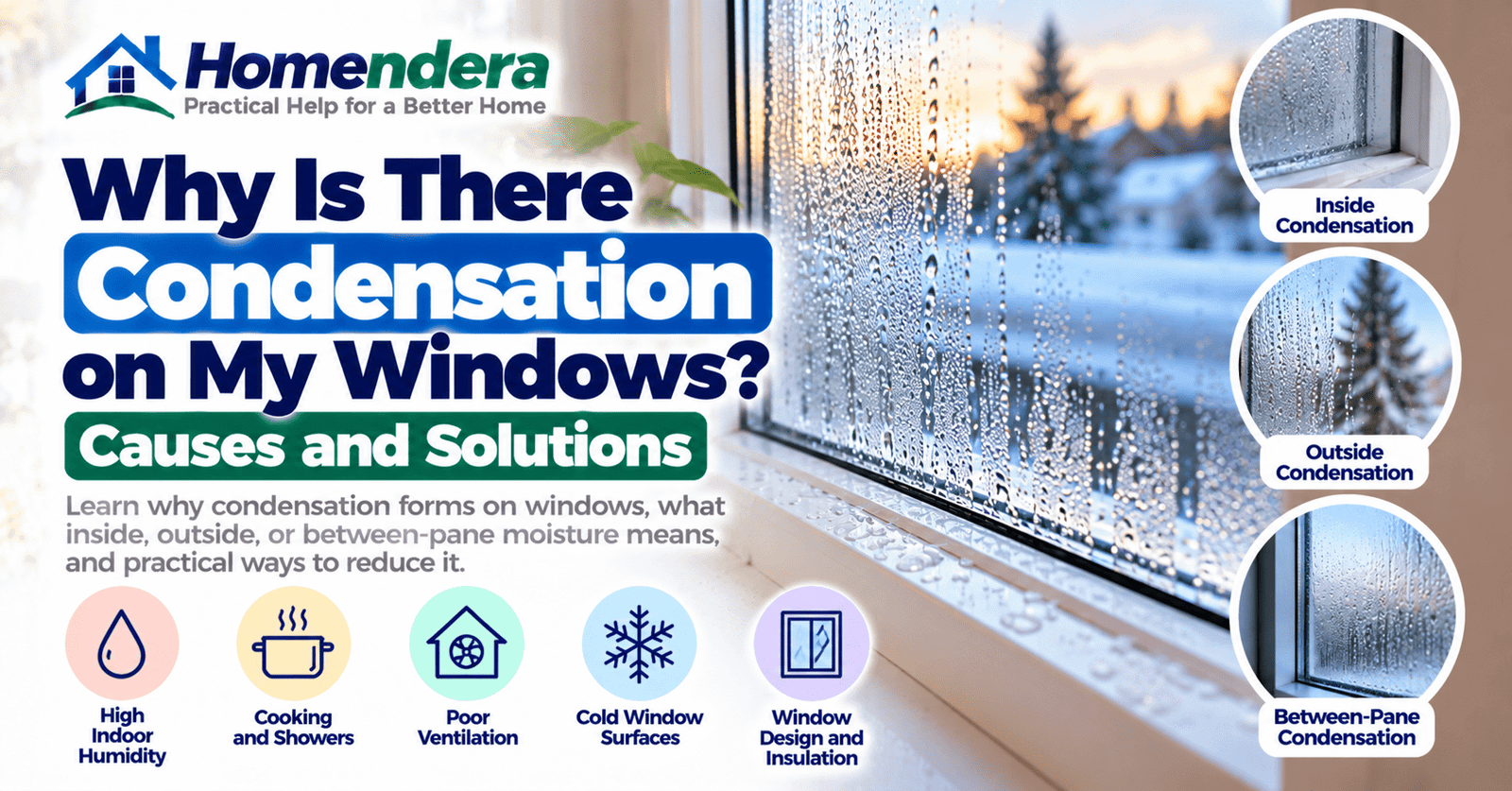
Water droplets on windows are common, especially during colder weather. A little temporary condensation does not always mean something is wrong with the window. However, frequent or heavy moisture can point to high indoor humidity, poor ventilation, cold window surfaces, or problems with the window itself.
If condensation remains for long periods, it can also wet frames, sills, walls, and nearby finishes.
Understanding why there is condensation on your windows can help you decide whether you simply need better moisture control or whether the window needs further investigation.
What Causes Window Condensation?
Condensation forms when moisture in the air meets a surface cold enough for water vapor to turn into liquid droplets.
Windows commonly show condensation because glass can become much colder than the surrounding indoor air.
Several factors affect how much condensation forms:
- Indoor humidity
- Outdoor temperature
- Window temperature
- Ventilation
- Window construction
- Insulation
- Everyday household activities
Before trying to fix the problem, determine where the condensation is forming.
1. Condensation on the Inside of Windows
Interior condensation appears on the room-facing surface of the glass.
This usually happens when warm, moisture-containing indoor air contacts cold glass.
You may notice it:
- Early in the morning
- During cold weather
- After cooking
- After showers
- In bedrooms overnight
- In rooms with limited ventilation
Occasional light condensation can occur under certain weather conditions. Persistent heavy condensation deserves more attention.
2. Condensation on the Outside of Windows
Exterior condensation forms on the outdoor surface of the glass.
This can happen when the exterior glass becomes cooler than humid outdoor air.
You may notice it during cool mornings when outdoor humidity is high.
Exterior condensation does not necessarily indicate a defective window. In some cases, well-insulated windows keep the exterior pane cooler because less indoor heat reaches it.
The moisture usually disappears as outdoor conditions change.
3. Condensation Between Window Panes
Moisture between panes of insulated glass is different.
Double- or triple-pane windows typically contain a sealed space between the panes.
If fogging or moisture appears inside that sealed space and cannot be wiped from either surface, the insulated-glass seal may have failed.
Signs can include:
- Persistent fogging
- Cloudy glass
- Droplets between panes
- Moisture that does not wipe away
Cleaning the window will not solve condensation trapped between sealed panes.
A window professional can determine whether the insulated glass unit can be replaced or whether another repair is appropriate.
4. High Indoor Humidity
High indoor humidity is one of the most common contributors to interior window condensation.
Everyday activities add moisture to indoor air.
Examples include:
- Showering
- Cooking
- Washing dishes
- Drying clothes indoors
- Breathing
- Using certain humidifiers
When outdoor temperatures fall, cold windows can become the first surfaces where that moisture becomes visible.
Our guide on the signs of excess moisture in your home covers other clues that indoor moisture may be too high.
5. Cooking Can Increase Condensation
Boiling water and preparing food can release substantial moisture.
If your kitchen windows fog while cooking, improve ventilation where practical.
Use an appropriately installed range hood if available, particularly one that exhausts outdoors.
Keep in mind that some range hoods recirculate air instead of exhausting it outside. These may help with grease and odors but may be less effective at removing moisture.
6. Showers Add Moisture to Indoor Air
Bathrooms can generate large amounts of water vapor.
Without adequate ventilation, that moisture can spread into nearby rooms and condense on colder windows.
Use the bathroom exhaust fan where one is installed and functioning correctly.
Allow it to continue operating for an appropriate period after bathing according to the fan manufacturer’s recommendations and local ventilation guidance.
Bathroom ventilation plays an important role in controlling indoor humidity. If steam remains after showers, our guide on bathroom exhaust fan not working explains possible causes and safe troubleshooting steps.
7. Bedrooms May Develop Condensation Overnight
Bedroom windows sometimes show more condensation in the morning.
People release moisture into the air while breathing, and closed bedroom doors or limited ventilation can allow humidity to build overnight.
The effect may be more noticeable when:
- Several people sleep in one room
- Windows are very cold
- Ventilation is limited
- Heavy curtains restrict air movement around the glass
If the problem occurs regularly, consider the room’s overall humidity and airflow rather than treating only the window.
8. Drying Clothes Indoors Can Add Moisture
Wet laundry releases water into the surrounding air as it dries.
Drying large amounts of clothing indoors can therefore increase humidity and window condensation.
Where possible, use appropriate ventilation.
If you use a clothes dryer designed to vent outdoors, make sure its venting system is installed and maintained according to the manufacturer’s instructions.
Never direct a vented dryer into an attic, wall cavity, crawl space, or other inappropriate indoor location.
9. Check Your Indoor Humidity
A basic hygrometer can help you monitor relative humidity.
However, there is no single perfect indoor humidity percentage for every home throughout the year.
Appropriate levels depend on:
- Outdoor temperature
- Climate
- Building construction
- Window performance
- Season
- Occupant comfort
During very cold weather, indoor humidity sometimes needs to be lower to prevent excessive condensation on cold surfaces.
The goal is to manage moisture according to your home’s conditions rather than chase one universal number.
10. Improve Bathroom Ventilation
If condensation becomes worse after showers, check the bathroom ventilation.
Make sure an exhaust fan grille is not heavily obstructed by dust.
If the fan operates but moisture remains excessive, the system may need further evaluation.
Do not dismantle electrical ventilation equipment unless you are qualified to work on it.
Also avoid assuming that opening a bathroom door alone provides adequate moisture removal.
11. Improve Kitchen Ventilation
Use kitchen ventilation during moisture-producing cooking.
Where appropriate:
- Use an exhaust hood
- Keep filters clean
- Follow manufacturer maintenance instructions
- Use lids on pots when practical
Ventilation can help remove moisture before it spreads throughout the home.
12. Be Careful With Humidifiers
Humidifiers can improve comfort in dry conditions, but excessive use can contribute to condensation.
If windows become heavily wet after you start using a humidifier, reduce its output and monitor indoor conditions.
Follow the manufacturer’s instructions for:
- Cleaning
- Water changes
- Placement
- Humidity settings
Poorly maintained humidifiers can create problems unrelated to window condensation as well.
13. Window Coverings Can Affect Condensation
Curtains, blinds, and shades can improve comfort and reduce unwanted heat transfer.
However, tightly closed coverings may also reduce warm room air circulation across the glass.
This can make the window surface colder and sometimes increase condensation behind the covering.
If you regularly find wet glass behind closed curtains, experiment with allowing more air circulation where appropriate.
Do not let curtains or other materials remain wet against the window.
14. Cold Window Glass Encourages Condensation
Even when indoor humidity is reasonable, very cold glass can develop condensation.
Older single-pane windows are particularly prone to cold interior surfaces.
Window construction affects surface temperature.
More energy-efficient windows can sometimes keep the interior glass warmer during winter, reducing the likelihood of interior condensation under similar conditions.
Our guide to energy-efficient home improvements discusses other ways to improve household comfort and reduce unwanted heat transfer.
15. Drafts and Condensation Are Different Problems
A draft means unwanted air is moving through or around an opening.
Condensation occurs when moisture-containing air contacts a sufficiently cold surface.
The two problems can sometimes occur together, but they are not the same.
If you feel air movement around the frame, our guide on how to stop drafts around doors and windows covers weatherstripping, caulk, door sweeps, alignment, and other common leakage points.
Do not assume that adding caulk will automatically solve condensation on the glass.
16. Inspect Window Weatherstripping
Damaged weatherstripping can allow unwanted air leakage and affect comfort around the window.
Check accessible seals for:
- Cracks
- Missing pieces
- Flattening
- Loose material
- Poor contact
Replace worn weatherstripping with a product appropriate for the window design.
Do not add so much material that the window can no longer close or lock correctly.
17. Inspect Caulk Around the Frame
Check stationary joints around the window frame.
Existing caulk may eventually:
- Crack
- Separate
- Shrink
- Peel away
Failed caulk may allow air or water intrusion.
Where resealing is appropriate, remove loose material, prepare the surface properly, and use a sealant suitable for the location.
Do not block manufacturer-designed drainage openings.
18. Do Not Block Window Weep Holes
Some windows include small openings that allow water to drain.
These are often called weep holes.
They may look like gaps that should be filled, but sealing them can trap water inside the window assembly.
Before caulking any opening in a window frame, determine whether it is an intentional drainage feature.
When uncertain, consult the window manufacturer’s documentation.
19. Wipe Away Persistent Condensation
Do not allow large amounts of water to sit repeatedly on window sills and frames.
Wipe away standing moisture.
Pay particular attention to windows with:
- Wooden frames
- Painted trim
- MDF or composite materials nearby
- Drywall directly beneath the sill
Removing the water does not correct the underlying cause, but it can help limit damage while you investigate.
20. Watch for Peeling Paint
Repeated condensation may eventually affect finishes around a window.
Look for:
- Peeling paint
- Bubbling
- Discoloration
- Soft trim
- Swelling
- Staining
These signs suggest that moisture is affecting more than the glass.
Do not simply repaint the area without first addressing the moisture source.
21. Check for Musty Odors
A persistent musty smell around a window deserves attention.
Inspect the sill, frame, trim, wall, and nearby furnishings for dampness.
Moisture may come from condensation, but it can also result from exterior water intrusion.
If the odor continues even when the glass is dry, investigate further.
22. Condensation vs a Window Leak
It is important to distinguish condensation from rainwater entering around a window.
Condensation usually forms across a cold glass surface under particular indoor and outdoor conditions.
Water intrusion may instead appear:
- During or after rain
- Around one corner of the frame
- Inside a wall
- Beneath the sill
- Around damaged exterior materials
If water appears mainly during rainfall, do not assume humidity is responsible.
Our guide on how to inspect your home for water damage can help you check surrounding materials.
23. Check Exterior Drainage Around the Window
Water entering around windows can involve more than caulk.
Exterior components such as flashing, siding, trim, or drainage details may be responsible.
Do not repeatedly add exterior sealant without identifying the actual water path.
Incorrect sealing can sometimes trap moisture instead of keeping it out.
Persistent rain-related leakage is a good reason to seek professional inspection.
24. What Does Condensation Between Panes Mean?
If moisture is clearly trapped between panes of insulated glass, improving room ventilation will generally not remove it.
This usually indicates a problem with the sealed glass assembly.
You may still be able to use the window, but its insulating performance or appearance may be affected.
A window professional can determine whether:
- The glass unit can be replaced
- The sash can be repaired
- Full window replacement is necessary
Do not assume the entire window must automatically be replaced.
25. Should You Replace Condensation-Prone Windows?
Not necessarily.
First determine where the condensation forms.
Inside surface: investigate indoor humidity, ventilation, and surface temperature.
Outside surface: often related to outdoor weather conditions.
Between panes: investigate insulated-glass seal failure.
Replacing a structurally sound window will not necessarily solve excessive indoor humidity.
Diagnose the cause before making an expensive decision.
26. Can a Dehumidifier Help?
A dehumidifier can help in some homes when indoor humidity remains excessive.
It may be particularly useful in damp basements or during humid weather.
However, a dehumidifier should not replace repairs for:
- Plumbing leaks
- Roof leaks
- Rainwater intrusion
- Failed drainage
- Wet building materials
If moisture returns rapidly despite dehumidification, investigate the source.
27. Consider the Whole Home
Heavy condensation on many windows usually deserves a whole-home view.
Check:
- Bathroom ventilation
- Kitchen ventilation
- Laundry practices
- Humidifier use
- Basement moisture
- HVAC operation
- Plumbing leaks
- Indoor humidity
Our home maintenance checklist can help you build these observations into regular household checks.
28. Do Not Make the Home Airtight Without Considering Ventilation
Air sealing can improve comfort and energy efficiency, but reducing uncontrolled leakage also increases the importance of proper ventilation.
Never block:
- Exhaust vents
- Combustion-air openings
- Appliance vents
- Required ventilation openings
Homes with fuel-burning equipment need particular care.
If you are planning extensive air-sealing work, professional advice may be appropriate.
29. When Should You Call a Professional?
Consider professional help when:
- Condensation remains excessive despite reasonable humidity control
- Moisture is trapped between glass panes
- Water enters during rain
- Frames are rotting or deteriorating
- Walls around the window remain damp
- Musty odors persist
- You suspect hidden water damage
- Several areas of the home have serious moisture problems
- You cannot determine whether the source is condensation or leakage
A window specialist, building professional, HVAC technician, or moisture professional may be appropriate depending on the suspected cause.
A Simple Window Condensation Checklist
When you notice condensation:
- Determine whether it is inside, outside, or between panes.
- Wipe away standing interior moisture.
- Consider recent cooking or showering.
- Check bathroom and kitchen ventilation.
- Review humidifier use.
- Check indoor humidity.
- Inspect weatherstripping and frame condition.
- Look for water damage around the sill.
- Determine whether moisture appears during rain.
- Seek professional help if the source remains unclear.
This prevents you from treating every type of window moisture as the same problem.
Final Thoughts
If you’re wondering why there is condensation on your windows, first determine exactly where the moisture is forming.
Interior condensation commonly relates to indoor humidity meeting cold glass. Exterior condensation can simply result from weather conditions. Moisture trapped between insulated glass panes may indicate a failed window seal.
Manage indoor moisture with appropriate ventilation, sensible humidity control, and good household habits. Wipe away persistent water before it damages surrounding materials.
Most importantly, distinguish ordinary condensation from actual water intrusion.
If moisture repeatedly damages frames, walls, or finishes—or appears between window panes—the problem deserves further investigation rather than another layer of caulk.