
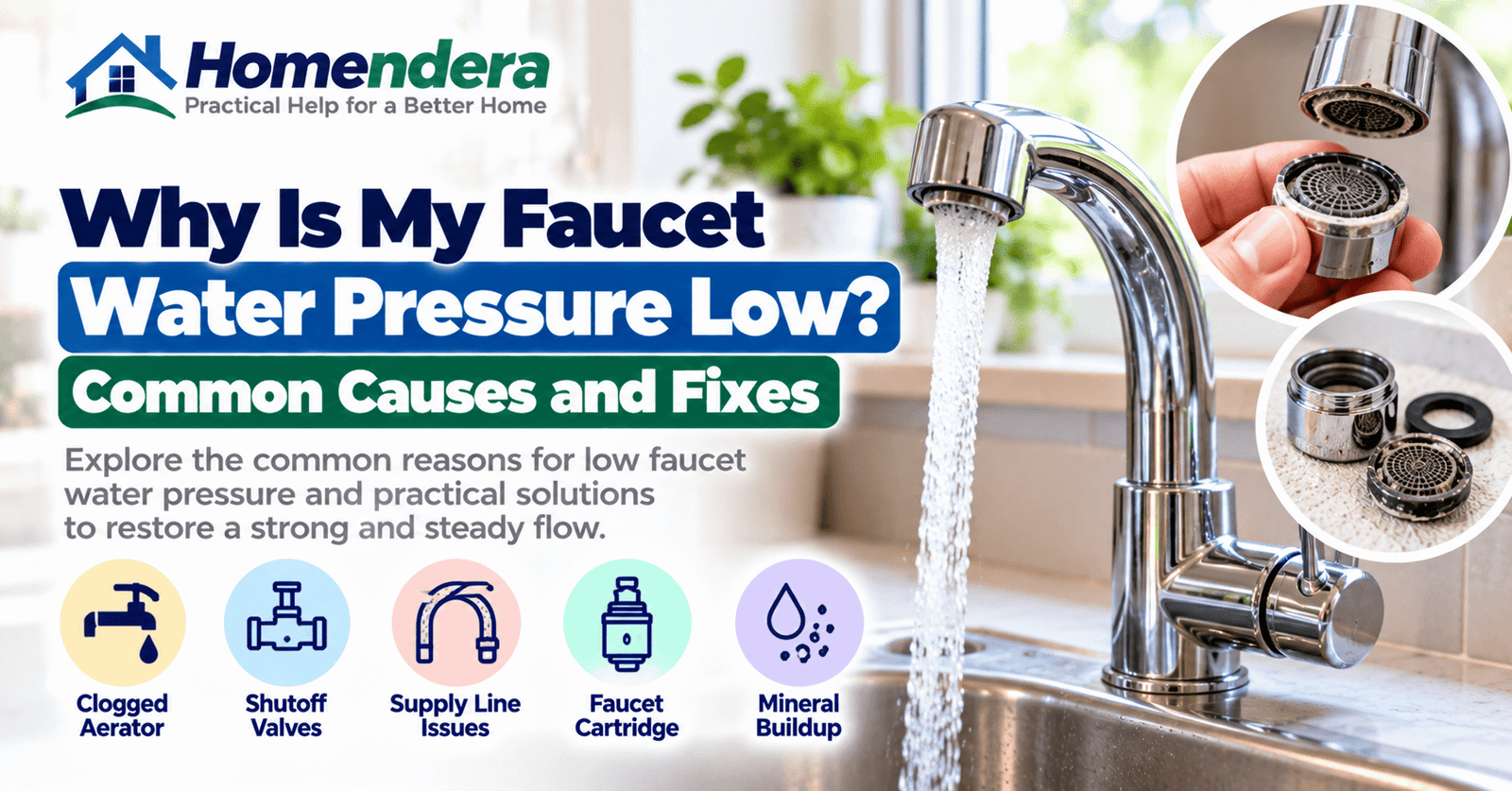
If you’re wondering why your faucet water pressure is low, the problem may be simpler than you think. A clogged aerator, partially closed shutoff valve, or kinked supply hose can reduce water flow from a single faucet.
Before replacing the faucet or calling a plumber, check whether other taps in your home have normal water pressure. If only one faucet is affected, the cause is often a local restriction rather than a problem with the entire plumbing system.
This guide explains how to identify the cause of weak faucet flow, check common problem areas safely, and decide when professional plumbing assistance is necessary.
How to Fix Low Faucet Water Pressure: Quick Checks
If one faucet has weak water flow, start with these simple checks:
- Test other faucets. Find out whether the problem affects one fixture or the entire home.
- Compare hot and cold water. Check whether both sides have weak flow or only one is affected.
- Inspect the aerator. Mineral deposits and small particles can block the screen at the faucet outlet.
- Clean the aerator carefully. If the manufacturer allows removal, clean visible debris and reinstall it correctly.
- Check the shutoff valves. Look beneath the sink for a partially closed valve, but never force a stuck or corroded one.
- Inspect supply hoses. Look for sharp bends, kinks, visible damage, or leaks.
- Consider internal faucet components. If the aerator is clean and the supply appears normal, the cartridge or another component may be restricted.
If several faucets have low water pressure, the problem may involve the main water supply, plumbing system, or pressure regulator. In that situation, follow our broader guide on why your water pressure is low.
If water is leaking, a valve is damaged, or the cause remains unclear, contact a qualified plumber.
First, Check Whether the Problem Affects One Faucet or the Whole Home
Before taking anything apart, test several fixtures.
Turn on faucets in different areas of the home and compare their water flow.
If only one faucet has weak flow, the problem is likely somewhere around that fixture.
If several faucets have suddenly lost pressure, the cause may involve the home’s plumbing system, water supply, pressure regulator, or another broader issue.
Our guide on why your water pressure is low covers whole-home pressure problems in more detail.
1. Check Both Hot and Cold Water
Test the hot and cold sides separately.
This simple check can provide an important clue.
If both hot and cold water have weak flow, a restriction near the faucet outlet may be responsible.
If only one side has poor flow, investigate components serving that particular supply.
For example, the issue could involve:
- A partially closed shutoff valve
- A kinked supply line
- Mineral buildup
- An internal faucet component
- A hot-water-related problem
Do not immediately replace the faucet before narrowing down the source.
2. Inspect the Faucet Aerator
The aerator is one of the first places to check when a single faucet has low water pressure.
It is usually fitted to the end of the faucet spout and helps control the water stream.
Small particles and mineral deposits can gradually restrict its openings.
Signs of a clogged aerator may include:
- Weak water flow
- Uneven spray
- Water spraying sideways
- Reduced flow from both hot and cold water
- Visible mineral deposits
An aerator can become restricted even when the rest of the plumbing works normally.
3. Remove the Aerator Carefully
Many aerators can be unscrewed from the faucet.
Before removing one, close the drain or cover it so that small parts cannot fall into the plumbing.
Try loosening the aerator by hand first.
If a tool is necessary, protect the faucet finish and avoid excessive force.
Some modern faucets use recessed or specialized aerators that require a manufacturer-specific key. Do not damage the fixture by forcing a component that is not designed for ordinary removal.
4. Inspect the Aerator for Debris
Once removed, examine the aerator carefully.
It may contain several small components, such as:
- Screens
- Flow-control pieces
- Washers
- Plastic inserts
Notice their orientation before separating anything.
Look for sand, sediment, rust particles, or mineral deposits.
Clean removable debris gently. If mineral buildup is substantial, follow cleaning recommendations appropriate for the aerator material.
Avoid damaging small screens or flow-control components.
5. Test the Faucet Without the Aerator
If appropriate for your faucet design, briefly run the water after removing the aerator.
Be prepared for a less controlled stream.
If the flow becomes noticeably stronger without the aerator, the restriction is probably within the aerator.
Clean or replace it with a compatible component.
If the water remains weak, continue investigating.
6. Check the Shutoff Valves
Most sinks have shutoff valves beneath them for the hot and cold water supplies.
If one has been partially closed, water flow may be reduced.
This sometimes happens after:
- Plumbing repairs
- Faucet replacement
- Cleaning beneath the sink
- Moving stored items
- Work on nearby plumbing
Inspect the valve position.
Do not force an old, corroded, or difficult valve. A deteriorated shutoff valve may begin leaking when disturbed.
If you are unsure about its condition, leave it alone and contact a plumber.
7. Inspect Flexible Supply Lines
Many faucets connect to shutoff valves through flexible supply hoses.
Look beneath the sink and check whether a hose is:
- Kinked
- Sharply bent
- Twisted
- Crushed by stored items
- Visibly damaged
- Leaking
A restricted hose can reduce water flow to the faucet.
Do not straighten an old or damaged hose aggressively. If its condition is questionable, replacement may be safer than manipulating it repeatedly.
8. Look for Water Under the Sink
Whenever you inspect faucet supply components, check for moisture.
Look around:
- Shutoff valves
- Supply hoses
- Faucet connections
- Drain pipes
- Cabinet surfaces
Water stains, dampness, swelling, or active droplets deserve attention.
Our guide on how to find a water leak in your home explains other signs that can help identify hidden plumbing problems.
A leak and low faucet flow occurring together should not be ignored.
9. Consider Mineral Buildup Inside the Faucet
Hard-water minerals can accumulate in more than the aerator.
Depending on the faucet design, deposits may affect internal passages or components.
This is more likely when:
- The aerator is clean
- Supply valves are open
- Supply hoses appear normal
- Other faucets have good pressure
- The affected faucet has gradually weakened over time
Internal faucet servicing varies significantly by model.
Manufacturer documentation can be useful before disassembling the fixture.
10. A Faucet Cartridge May Be Restricting Flow
Many modern faucets use cartridges to control water flow and temperature.
A worn, damaged, or clogged cartridge may reduce flow.
Possible symptoms include:
- Weak flow
- Difficulty adjusting temperature
- Uneven hot and cold flow
- A stiff handle
- Dripping
- Changes in faucet operation
Cartridge replacement is more involved than cleaning an aerator.
Identify the faucet model and use the manufacturer’s instructions before attempting this repair.
11. Check Whether the Problem Started After Plumbing Work
Low faucet pressure sometimes appears immediately after repairs elsewhere in the home.
Plumbing work can disturb sediment inside pipes. Small particles may then travel through the system and collect in an aerator or faucet component.
If the problem began after:
- Water was shut off
- A pipe was repaired
- A water heater was serviced
- A valve was replaced
- Other plumbing work occurred
checking the aerator is particularly worthwhile.
12. Compare Nearby Faucets
Testing nearby fixtures can help narrow down the problem.
Suppose the kitchen faucet has weak flow but a nearby bathroom faucet works normally.
That suggests the issue may be localized.
However, if several fixtures in the same area have weak pressure, the problem may involve a branch of the plumbing system rather than a single faucet.
The more fixtures affected, the less likely an aerator alone is responsible.
13. Check Whether Low Pressure Occurs Only With Hot Water
If cold water flows normally but hot water is weak, the faucet aerator may not be the main problem.
Possible causes can include:
- A partially closed hot-water shutoff valve
- A restricted supply hose
- Faucet cartridge problems
- Issues elsewhere in the hot-water system
If hot-water pressure is low at several fixtures, investigate the broader hot-water supply rather than dismantling individual faucets.
Water-heater and pressurized hot-water system problems may require professional service.
14. Check Whether Low Pressure Occurs Only With Cold Water
The same reasoning applies when only the cold side is weak.
Inspect the accessible cold-water shutoff valve and supply hose for obvious problems.
If several cold-water fixtures are affected, the cause may be elsewhere in the supply system.
Avoid repeatedly adjusting valves when you do not know their condition.
Older valves can fail or begin leaking after being disturbed.
15. Pull-Down and Pull-Out Faucets Need Additional Checks
Kitchen faucets with pull-down or pull-out spray heads contain additional components that can restrict flow.
Depending on the model, check for:
- A clogged spray head
- Mineral deposits
- A kinked hose
- Hose movement problems
- A diverter issue
- Internal flow restrictions
Clean accessible spray openings according to the manufacturer’s instructions.
Do not insert sharp tools into small nozzles because this can damage them.
16. Check the Spray Pattern
The way water exits the faucet can reveal useful information.
For example:
Weak but even flow:
There may be a general restriction.
Water spraying sideways:
The aerator may contain debris or mineral deposits.
Some spray openings blocked:
A spray head may have localized buildup.
Flow changes when the hose moves:
A flexible hose may be kinked or damaged.
Observe the symptom before choosing a repair.
17. Do Not Confuse Flow Rate With Water Pressure
People often use “water pressure” and “water flow” to describe the same problem, but technically they are different.
A faucet may have weak flow because something restricts the outlet even when the plumbing system’s pressure is normal.
For example, a clogged aerator reduces the amount of water leaving the faucet.
That is why checking whether other fixtures behave normally is so important.
A single weak faucet often points toward a localized flow restriction rather than a whole-house pressure problem.
18. Could the Faucet Be Designed to Use Less Water?
Some faucets contain flow restrictors designed to reduce water consumption.
Therefore, a lower flow rate does not automatically indicate a fault.
If the faucet has always behaved the same way, check its specifications before modifying anything.
Do not remove manufacturer-installed water-saving components merely to increase flow. They may be part of the fixture’s intended design or required by local efficiency standards.
A sudden change in flow is more useful diagnostically than simply comparing one faucet with a different model.
19. What If Several Faucets Have Low Pressure?
If low flow affects multiple fixtures, stop focusing on the individual faucet.
Broader causes can include:
- Main supply issues
- A partially closed main valve
- Pressure regulator problems
- Pipe restrictions
- Leaks
- Water utility issues
- Plumbing system problems
Our broader guide on why your water pressure is low is the better troubleshooting starting point in this situation.
A plumber may need to measure actual water pressure to determine what is happening.
20. Sudden Pressure Loss Deserves Attention
A gradual decline at one faucet often points toward buildup.
Sudden pressure loss throughout the home can be more significant.
Check for obvious signs of water leakage and determine whether neighbors or your water supplier are experiencing a service problem where applicable.
Unexpected changes accompanied by water stains, unusual sounds, or visible leakage should be investigated promptly.
21. Avoid Randomly Adjusting the Pressure Regulator
Some homes use a pressure-reducing valve or pressure regulator.
Do not adjust it simply because one faucet has weak flow.
A regulator affects the broader plumbing system, and incorrect adjustment can create excessive pressure.
First establish whether the problem actually affects the whole home.
Professional pressure testing is sensible when a regulator problem is suspected.
22. Avoid Forcing Plumbing Components
Low faucet pressure is usually inconvenient rather than an emergency, so there is rarely a reason to force stuck components.
Stop if:
- An aerator will not loosen
- A shutoff valve is seized
- A connection begins leaking
- A hose looks deteriorated
- Faucet components appear damaged
- You are uncertain how the fixture comes apart
Turning a small problem into a broken valve or leaking connection creates unnecessary repair work.
23. When Should You Call a Plumber?
Consider professional help when:
- Several fixtures have low pressure
- Pressure suddenly drops throughout the home
- A shutoff valve is damaged or leaking
- Supply hoses appear deteriorated
- The faucet remains weak after cleaning the aerator
- Internal faucet components are difficult to service
- You suspect a pipe restriction
- Water leaks are present
- Pressure repeatedly changes without an obvious reason
A plumber can also measure actual system pressure and distinguish a fixture problem from a supply problem.
24. How to Help Prevent Faucet Flow Problems
A few simple habits may reduce future problems.
Periodically:
- Observe changes in faucet flow
- Clean accessible aerators when necessary
- Watch for mineral buildup
- Keep under-sink storage away from supply hoses
- Inspect beneath sinks for moisture
- Address dripping faucets
- Investigate sudden changes promptly
Our guide on how to fix a dripping faucet can help if reduced flow is accompanied by a persistent drip.
Weak water flow can also affect bathroom showers. If your shower produces less water than usual, see our guide on common causes of low shower water pressure for practical troubleshooting advice.
Final Thoughts
If you’re wondering why your faucet water pressure is low, first determine whether the problem affects one faucet or multiple fixtures.
For a single faucet, start with the aerator. Mineral deposits and small debris commonly restrict water flow. Next, inspect accessible shutoff valves and supply hoses, and compare the hot and cold sides.
If several fixtures have weak pressure, the issue may be broader than the faucet.
Diagnose before replacing parts. A simple aerator cleaning may solve a localized problem, while widespread or sudden pressure changes may require professional plumbing investigation.