
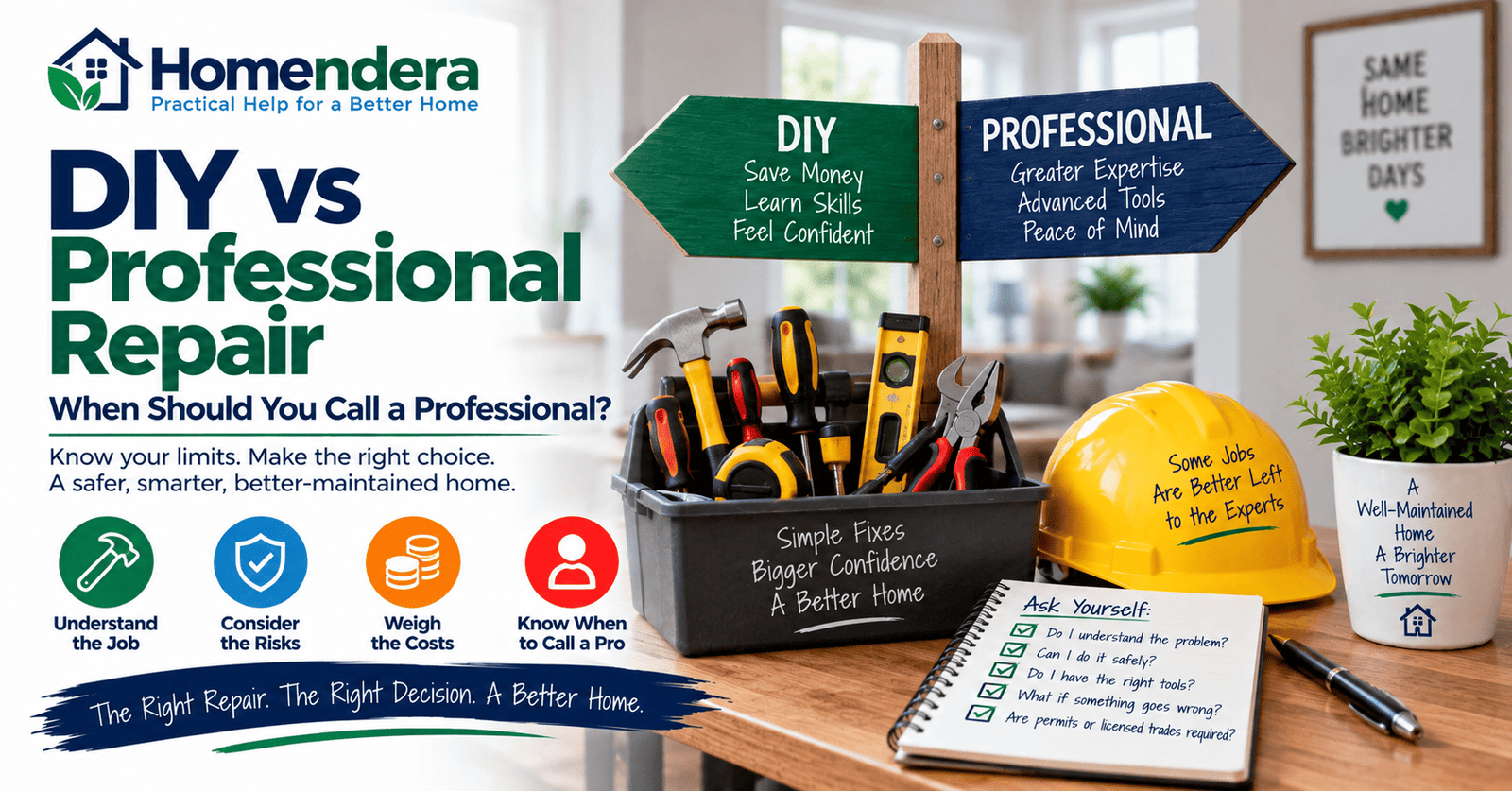
DIY repairs can save time and money. They can also help you understand how different parts of your home work. Tightening loose hardware, patching a small drywall hole, or fixing a squeaky hinge may be reasonable projects for many homeowners.
However, not every repair belongs on a DIY list.
Some jobs involve electricity, gas, structural components, dangerous heights, contaminated water, or specialized equipment. In these situations, a mistake can cost far more than the original repair.
Understanding DIY vs professional repair is therefore an important homeownership skill. The goal is not to avoid professionals whenever possible. It is to recognize which jobs you can reasonably handle and when specialist knowledge, equipment, licensing, or experience matters.
For examples of manageable projects, see our Basic DIY Home Repairs Every Homeowner Should Know guide.
What Makes a Good DIY Repair?
A suitable DIY project usually has several characteristics.
The problem is reasonably easy to identify. The repair has limited safety risks, and a mistake is unlikely to cause serious property damage.
You should also have the appropriate tools and understand the steps before starting.
Examples may include:
- Tightening ordinary cabinet hardware
- Fixing a simple squeaky hinge
- Patching a small cosmetic drywall hole
- Replacing suitable weatherstripping
- Adjusting certain cabinet doors
- Touching up minor paint damage
- Fixing a loose toilet seat
- Cleaning an accessible faucet aerator where appropriate
Even simple jobs require judgment.
A loose handle may be easy to fix, while a loose electrical outlet involves a very different level of risk.
Five Questions to Ask Before Starting Any DIY Repair
Before picking up your tools, ask yourself five questions.
1. Do I Understand the Problem?
A successful repair starts with diagnosis.
If you do not know why something has failed, replacing or adjusting parts may simply hide the real problem.
For example, sanding a sticking door might seem sensible. However, a loose hinge could actually be causing the misalignment.
Our guide on how to fix a door that won’t close properly shows why diagnosis should come before modification.
2. Can I Perform the Work Safely?
Think beyond whether you know the steps.
Consider electricity, gas, water, sharp tools, moving components, heat, chemicals, ladders, confined spaces, and the weight of anything you need to move.
If controlling these hazards requires knowledge or equipment you do not have, professional assistance may be appropriate.
3. What Happens If I Make a Mistake?
This is one of the most useful questions in DIY.
A poor drywall patch may look unattractive. You can often redo it.
A mistake involving electrical wiring, structural support, gas, or waterproofing can have much greater consequences.
The potential severity of failure should influence your decision.
4. Do I Have the Right Tools?
Improvising with unsuitable tools can damage fasteners, materials, equipment, and sometimes the person doing the work.
You do not necessarily need professional-grade equipment for every simple repair.
However, if the job requires specialized diagnostic, safety, or installation equipment, hiring someone who already has it may make more sense.
5. Are There Legal or Permit Requirements?
Some home repairs are regulated.
Requirements vary by location and may depend on the type and extent of work.
Electrical, plumbing, gas, structural, and other projects can sometimes require permits, inspections, or licensed professionals.
Before undertaking substantial work, check the rules that apply where the property is located.
When DIY Usually Makes Sense
DIY tends to make the most sense when the job is:
- Low risk
- Clearly understood
- Relatively small
- Accessible
- Reversible or easy to correct
- Within your existing skills
- Possible with ordinary appropriate tools
- Not restricted by local requirements
Your experience also matters.
A project that is straightforward for an experienced homeowner may not be suitable for someone using a particular tool or technique for the first time.
There is nothing wrong with learning. Start with manageable projects where mistakes have limited consequences.
When Professional Repair Makes More Sense
Professional help becomes more valuable as risk, complexity, uncertainty, or potential damage increases.
You should be more cautious when a repair involves:
- Electrical systems
- Gas
- Structural components
- Major plumbing
- Roofing
- Dangerous heights
- HVAC technical components
- Refrigerants
- Extensive water damage
- Sewage or contaminated water
- Hazardous materials
- Specialized safety systems
The presence of one of these factors does not tell you exactly which professional you need. It does tell you to consider the risks before treating the job as ordinary DIY.
Electrical Problems Need Extra Caution
Electrical work deserves a clear boundary.
Replacing batteries in a household device is very different from modifying fixed wiring.
Warning signs such as burning smells, sparks, damaged wiring, overheating, repeated breaker trips, or unexplained electrical behavior should not be treated as simple experiments.
Never assume equipment is electrically safe merely because a nearby switch is off.
Electrical systems can retain or receive power in ways an inexperienced person may not expect.
Use an appropriately qualified electrician when the work involves meaningful electrical hazards or when local rules require one.
Gas Repairs Are Not Ordinary DIY
Gas systems can create fire, explosion, and health hazards.
If you smell gas or suspect a leak, do not begin dismantling equipment to find the source yourself.
Follow the emergency guidance of your local gas provider or relevant authorities and move to safety as appropriate.
Installation, alteration, or repair of gas lines and gas-burning equipment may require qualified or licensed professionals depending on local requirements.
This is an area where saving money through experimentation can create unacceptable risk.
Structural Problems Need Proper Assessment
Cracks do not automatically mean a home has a structural problem.
Many buildings develop minor cosmetic cracks over time.
However, certain combinations of symptoms deserve more attention, including significant or changing cracks, noticeable movement, sagging, major floor changes, or several doors and windows becoming misaligned.
Avoid making your own structural diagnosis based on a single visible symptom.
A suitably qualified building or structural professional can assess conditions that appear significant or progressive.
Major Plumbing Problems Can Escalate Quickly
Some plumbing tasks are relatively simple.
Cleaning an accessible faucet aerator or removing hair from a suitable drain strainer is different from repairing concealed supply pipes or dealing with a major leak.
Consider professional plumbing assistance when you encounter:
- Significant active leakage
- Hidden leaks
- Repeated drainage backups
- Several blocked fixtures
- Sewage
- Damaged main water lines
- Water heater problems
- Plumbing you cannot safely isolate
- Repairs beyond your knowledge
Water can spread beyond the visible area, so delays may increase property damage.
Water Damage May Require More Than One Professional
Finding water damage does not automatically tell you who should repair it.
The source might involve plumbing, roofing, HVAC equipment, exterior drainage, an appliance, or another building component.
Start by identifying the likely source without exposing yourself to hazards.
Our guide on how to inspect your home for water damage explains the warning signs and areas worth checking.
Large-scale water damage, contaminated water, structural deterioration, or moisture near electrical systems can require specialist assistance.
Roof Repairs Carry Serious Fall Risks
A roof problem may look easy from the ground.
Working on the roof is different.
Height, slope, weather, fragile materials, access, and equipment can all increase risk.
For routine observation, inspect the roof from a safe ground-level location where possible.
Missing or displaced materials can sometimes be identified without climbing.
Repairs that require dangerous access are often better handled by an appropriately equipped professional.
HVAC Maintenance and HVAC Repair Are Different
Homeowners can often perform certain basic heating and cooling maintenance tasks.
For example, an accessible filter may be designed for homeowner inspection or replacement.
Technical HVAC repair can involve:
- High-voltage electricity
- Fuel or combustion
- Refrigerants
- Pressurized systems
- Moving components
- Specialized diagnostics
Do not confuse routine maintenance with equipment repair.
Follow manufacturer instructions and use a qualified HVAC technician when the work goes beyond appropriate homeowner maintenance.
Be Careful With Water Heaters
Water heaters combine several potential hazards.
Depending on the type, they can involve electricity, gas, combustion, hot water, pressure, and venting.
Looking for visible leakage around an accessible unit can be part of routine maintenance.
Dismantling safety components or attempting technical repairs is another matter.
If the water heater leaks significantly, behaves abnormally, or presents a safety concern, professional assessment is appropriate.
Mold and Moisture Problems Can Be Complicated
A small amount of surface discoloration and extensive moisture damage are not the same problem.
The most important step is addressing the moisture source.
Large affected areas, recurring moisture, hidden damage, contaminated materials, or uncertainty about the extent of the problem may justify professional assessment.
Do not simply paint over moisture-related deterioration.
The visible surface may be only part of the affected area.
Hazardous Materials Change the DIY Decision
Some older homes can contain materials that require special precautions when disturbed.
Depending on the age, location, and construction of the property, renovation work can potentially encounter materials such as lead-containing paint or asbestos-containing products.
Do not identify hazardous materials based only on appearance.
If a planned project may disturb a suspect material, appropriate testing, local requirements, and professional guidance may be necessary.
Heavy Objects Can Turn Simple Jobs Into Dangerous Ones
A repair does not need electricity or gas to cause injury.
Heavy doors, appliances, cabinets, glass, fixtures, and building materials can be difficult to control.
Think about the weight before removing supports or fasteners.
A task that requires two people should not become a one-person job simply because you want to finish quickly.
Use appropriate lifting techniques and equipment, and get assistance where necessary.
Ladders Deserve More Respect Than They Get
Many home-maintenance injuries happen during seemingly ordinary tasks at height.
Before using a ladder, consider the surface, height, access, weather, and task.
Reaching sideways, standing on unsuitable objects, or using equipment incorrectly can turn a minor repair into a serious accident.
If safe access is difficult, professional help can be a sensible choice.
Consider the Cost of Getting It Wrong
DIY decisions are often based on the cost of hiring someone.
That is only half of the calculation.
Also consider:
- Cost of replacement materials
- Damage caused by an incorrect repair
- Specialized tools you must purchase
- Time required to learn and complete the job
- Possible repeat work
- Safety risks
- Permit or inspection costs
- Consequences for warranties
- Cost of correcting failed DIY work
Sometimes DIY remains clearly worthwhile.
In other situations, professional repair can be the more economical choice once the full risk is considered.
Do Not Let Sunk Costs Control the Decision
Imagine you have already spent several hours and bought materials for a repair.
Then you discover that the problem is more complicated than expected.
Do not continue simply because you have already invested time and money.
Stopping is an option.
A sensible DIYer knows when new information changes the original plan.
Know When a Small Repair Has Become a Bigger Job
Projects sometimes reveal hidden problems.
You remove damaged material and discover moisture. A simple adjustment reveals broken hardware. A small stain turns out to be associated with an active leak.
At that point, reassess the job.
Do not automatically continue into work you did not originally plan or prepare for.
Unexpected conditions are one of the strongest reasons to stop and reconsider whether professional help is appropriate.
When You Can Learn the Repair Safely
Not knowing how to do something does not automatically mean you need a professional.
DIY skills develop through learning.
Good beginner projects usually allow you to:
- Understand the complete process first
- Use ordinary tools safely
- Work without dangerous systems
- Stop easily if something goes wrong
- Correct mistakes without major consequences
Our guide on how to patch small holes in drywall is a good example of a repair where beginners can develop basic preparation and finishing skills without entering a high-risk system.
When a Professional May Save Time
Even a safe DIY project may not always be worth doing yourself.
A professional may complete in an hour what would take you an entire weekend.
That does not automatically make hiring someone better. Your budget, interest, available time, and desire to learn all matter.
The key is to make the choice deliberately rather than assuming DIY always saves money.
How to Choose the Right Type of Professional
Different problems require different expertise.
Depending on the job, you might need a:
- Plumber
- Electrician
- HVAC technician
- Roofer
- Carpenter
- Appliance technician
- General contractor
- Structural professional
- Water-damage specialist
- Other qualified trade professional
Choose someone whose expertise matches the actual problem.
For regulated work, check licensing or other local requirements where applicable.
Questions to Ask Before Hiring Someone
For substantial work, asking a few questions can help you understand what is being proposed.
Consider asking:
- What do you believe is causing the problem?
- What work do you recommend?
- Are there alternatives?
- What is included in the price?
- Does the work require permits or inspections?
- What qualifications or licensing apply?
- What warranty applies to the work?
- What preparation should I complete beforehand?
For larger projects, a written description or estimate can reduce misunderstandings.
Warning Signs That Mean Stop the DIY Project
Stop and reassess if you discover:
- Unexpected electrical wiring
- A gas-related issue
- Significant active water leakage
- Sewage
- Structural damage
- Suspected hazardous materials
- Unstable building components
- Equipment you cannot safely isolate
- A repair requiring dangerous access
- Conditions substantially different from what you expected
Stopping is not a failed repair.
It is a safety decision based on new information.
DIY Does Not Mean Cutting Corners
Doing something yourself does not remove the need for good materials, correct preparation, manufacturer instructions, or local requirements.
Temporary shortcuts can become long-term problems when they are forgotten.
Our Common Home Maintenance Mistakes and How to Avoid Them guide discusses several ways apparently small shortcuts can create unnecessary repairs later.
Create Your Own DIY Limits
Every homeowner has a different skill level.
It can help to decide in advance what types of work you are comfortable doing.
For example, you may be comfortable with painting, basic hardware, drywall patches, and minor adjustments while choosing professionals for fixed electrical wiring, gas, roofing, and major plumbing.
Your limits can change as you gain legitimate skills and experience.
Safety should remain the deciding factor.
A Simple DIY or Professional Decision Checklist
Before beginning a repair, ask:
Do I know the cause?
If not, diagnose further.
Is there a meaningful safety hazard?
If yes, consider professional help.
Can a mistake cause major damage?
If yes, think carefully before proceeding.
Do I have the correct tools and skills?
If not, determine whether they can reasonably and safely be acquired.
Are permits or licensed trades required?
Check local rules.
Can I stop safely if something unexpected happens?
If not, the job may not be suitable for DIY.
Would professional repair make more sense overall?
Consider cost, time, risk, and complexity together.
Final Thoughts
The choice between DIY vs professional repair should depend on more than whether you can find instructions online.
Simple, low-risk repairs can be excellent DIY projects. They help you maintain your home, build useful skills, and avoid unnecessary service calls.
Higher-risk work deserves a different approach.
Electricity, gas, structural components, major plumbing, roofing, technical HVAC systems, hazardous materials, and extensive damage can require specialist knowledge and equipment.
Before every repair, understand the problem, consider what could go wrong, and decide whether you can perform the work safely.
A capable homeowner is not someone who repairs everything personally. It is someone who knows which problems to handle, which ones to investigate further, and when to bring in the right professional.